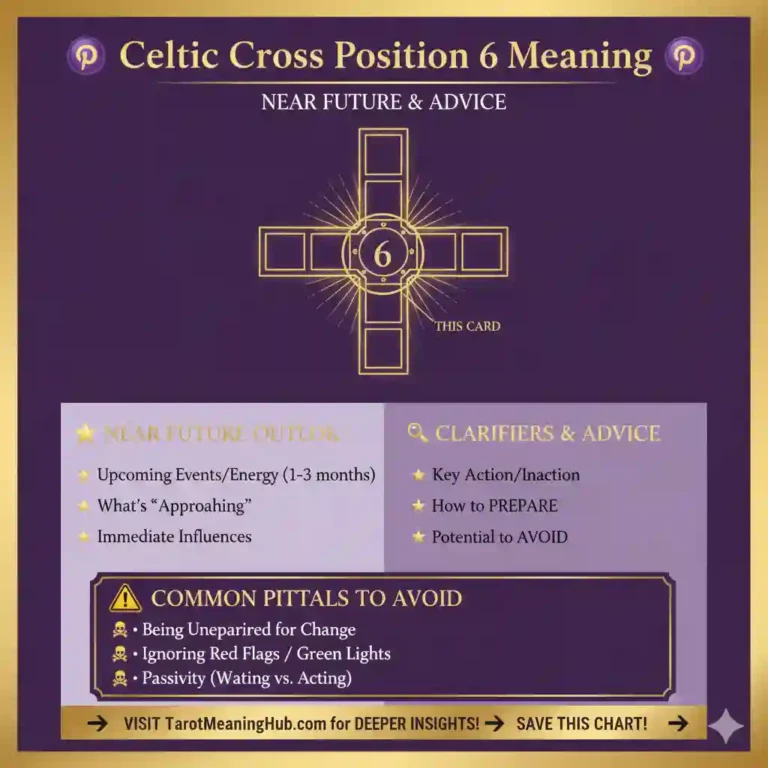
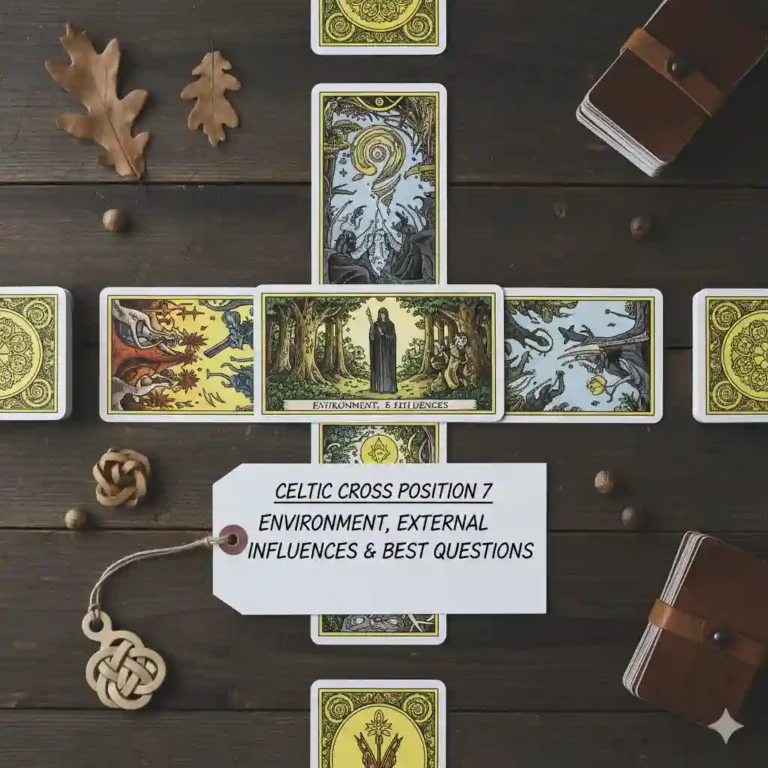
Celtic Cross Position 1 — Clarifiers, Core Energy & Common Pitfalls
Celtic Cross Position 1 represents the core energy of the querent’s current situation. It reflects what is happening right now, both on the surface and at a deeper energetic level, anchoring the entire spread. This card distinguishes between the obvious facts of a situation and its underlying energetic truth. Because it sets the foundational tone for the reading, misinterpreting Position 1 can distort the meaning of every other card and lead to a completely inaccurate interpretation.
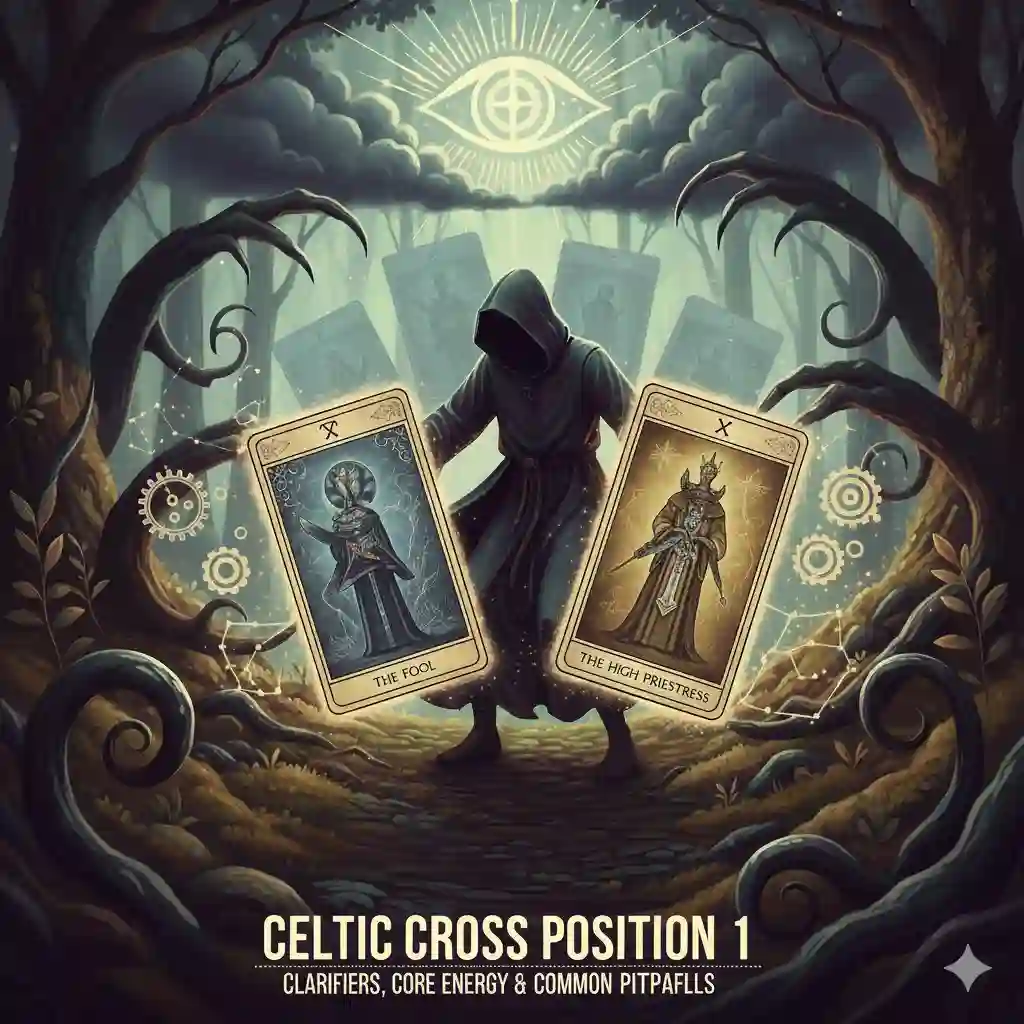
The Celtic Cross is one of the most comprehensive and respected diagnostic tools in tarot. It doesn’t just predict an outcome; it maps the intricate web of energies surrounding a situation. At the very heart of this map lies Position 1, representing the present moment and the querent’s core energy. However, this foundational card is frequently misunderstood, with many readers mistaking it for the challenge or problem, a role reserved for Position 2. This common error can derail a reading from the start. Furthermore, the misuse of clarifier cards in this position often adds confusion rather than clarity. This guide provides the most detailed explanation of Celtic Cross Position 1 available, designed to empower both new and experienced readers with the confidence to interpret it accurately.
Core Meaning of Celtic Cross Position 1
The first card in the Celtic Cross represents the “heart of the matter.” It is a snapshot of the querent’s present state of being and the central theme of the inquiry. This position encapsulates the primary energy that defines the situation at the moment of the reading. It is not just about external events; it speaks to the internal landscape, including the querent’s conscious thoughts and unconscious feelings. This card reveals the emotional, mental, and situational layers that make up the querent’s current reality.
Crucially, Position 1 is not the “problem” card. It simply shows “what is.” The card that crosses it, Position 2, is the one that signifies the immediate challenge or obstacle. The card in Position 1 is neutral; it is the environment in which the story of the spread unfolds. Understanding this distinction is fundamental to an accurate reading. For a comprehensive overview of the entire layout, see our complete guide to the Celtic Cross tarot spread.
Understanding the purpose of the next section is crucial for avoiding a common trap in tarot reading. Many readers, when faced with an ambiguous card in Position 1, immediately reach for more cards. However, knowing when to use clarifiers—and when not to—is a skill that separates a clear reading from a confusing one.
When (and When NOT) to Use Clarifier Cards for Position 1
Clarifier cards are additional cards drawn to provide more detail or context for a card that feels ambiguous or multi-layered. Their purpose is to shed light on the primary card, not to replace or contradict it. For Position 1, a clarifier should only be pulled when you have sat with the initial card and its meaning in the context of the question remains genuinely unclear. Signs that a clarifier may be needed include a Major Arcana card with broad implications (like The World or The Fool) or a court card that could represent the querent, another person, or an aspect of the personality.
However, pulling clarifiers unnecessarily can weaken a reading. If your first instinct is to pull another card before you’ve fully considered the first one, you are likely avoiding the message it holds. Over-clarifying is a significant pitfall that creates “noise” and buries the core message under too much information. As a rule, if the card in Position 1 makes sense on an intuitive level, trust that instinct. Do not pull a clarifier just to confirm what you already know or hope for a different answer. A clarifier is a tool for focus, not a second opinion.
Now that we know when to consider a clarifier, it’s important to understand how these extra cards interact with the primary card. A clarifier doesn’t just add information; it fundamentally shifts and deepens the energy of the position it is clarifying.
How Clarifiers Change the Energy of Position 1
When used correctly, clarifiers act as amplifiers or modifiers, not replacements. They add a new layer of meaning that helps you understand the nuances of the card in Position 1. For example, if The Tower appears as the core situation, it signifies sudden, disruptive change. A clarifier like the Ten of Cups could suggest this upheaval is ultimately leading to emotional fulfillment and family harmony, whereas a clarifier like the Nine of Swords would amplify the anxiety and fear associated with the change.
Think of the primary card and its clarifier as forming a sentence. The first card is the subject, and the clarifier is the adjective or adverb that describes it. This approach helps you read them together as a single, cohesive message. An upright clarifier often builds upon the theme of the first card in a straightforward way. A reversed clarifier might point to a blocked, internal, or hidden aspect of the Position 1 energy. A clarifier can reveal whether the core situation is rooted in an emotional state (Cups), a practical matter (Pentacles), a conflict or action (Swords), or a creative or spiritual drive (Wands).
Mistakes are a natural part of learning, but some interpretive errors can fundamentally distort a reading. The following section outlines the most common pitfalls associated with Position 1, ensuring you can identify and avoid them.
Common Pitfalls When Reading Celtic Cross Position 1
The accuracy of an entire Celtic Cross spread hinges on the correct interpretation of its first card. Several common mistakes can lead readers astray, distorting the narrative from the very beginning.
- Confusing Position 1 with Position 2: This is the most frequent error. Position 1 is the situation; Position 2 is the challenge. Reading The Lovers in Position 1 as “a difficult choice” is incorrect. It represents a state of harmony, connection, or choice itself. The difficulty would only appear if a challenging card lands in Position 2.
- Reading the Card Too Literally: Tarot is a symbolic language. The Death card in Position 1 rarely means a physical death; it points to a significant ending or transformation. Readers must look beyond the most obvious interpretation to see the emotional and energetic undertones.
- Ignoring Emotional Undertones: Every card has an emotional frequency. The Five of Cups is not just about loss; it is about the grief and regret that accompany it. Failing to address the feeling behind the card leaves the querent with an incomplete picture of their present state.
- Letting Personal Bias Override Symbolism: A reader who has had a negative experience with a specific situation may project that bias onto a card. For instance, seeing the Three of Pentacles (teamwork, collaboration) and interpreting it as “being taken advantage of at work” due to personal history is a distortion.
- Over-pulling Clarifiers: As discussed, pulling too many cards creates confusion, not clarity. It often stems from a lack of confidence in one’s intuitive ability to read the first card. Trust the card you pulled.
To build on the most critical pitfall, the next section provides a focused look at the relationship between Position 1 and Position 2. Mastering this distinction is non-negotiable for accurate readings.
Position 1 vs Position 2 — The Most Misunderstood Difference
The relationship between the first two cards of the Celtic Cross forms the central axis of the reading. Grasping their distinct roles is essential for accuracy. Position 1 shows the core situation, while Position 2 shows what is “crossing” it—the immediate obstacle or, sometimes, a supporting energy.
Think of it this way:
- Situation vs. Obstacle: Position 1 is the landscape. Position 2 is the roadblock you encounter while traveling through it. If Position 1 is the Ten of Pentacles (security, family), Position 2 could be the Five of Wands (conflict), showing that family disagreements are currently challenging that security.
- Energy vs. Interference: Position 1 is the primary energy field. Position 2 is the force that interferes with or complicates that energy.
- What Is vs. What Blocks: Position 1 is the state of “being.” Position 2 is what prevents or helps that state from evolving smoothly.
Mentally separating these two roles is critical. Before interpreting the rest of the spread, pause and articulate the dynamic between these two cards. For example: “The core situation is about finding emotional fulfillment (Nine of Cups), but it is being blocked by a fear of the unknown (The Moon).” This foundational understanding prevents the entire reading from becoming skewed. To learn more, explore our guide on understanding tarot spread position relationships.
The universal meaning of Position 1 adapts to the specific context of the querent’s question. The following section explores how to tailor your interpretation for common areas of inquiry like love, career, and spirituality.
Reading Position 1 in Love, Career & Spiritual Questions
The meaning of the card in Position 1 shifts its focus depending on the nature of the question. Its core symbolism remains the same, but its application becomes more specific.
- Love Readings: In a love reading, Position 1 often reveals the querent’s true emotional reality versus their wishful thinking. A card like the Seven of Cups might represent being lost in romantic fantasies rather than engaging with a real partner. The Two of Cups would indicate a present state of genuine connection and mutual affection.
- Career Readings: For career questions, Position 1 speaks to the querent’s current professional state. The Eight of Pentacles suggests a period of diligent work and skill development, indicating stability and focus. Conversely, the Four of Cups could point to underlying dissatisfaction and apathy with their current role, even if it appears stable on the surface.
- Spiritual Readings: When inquiring about one’s spiritual path, Position 1 reflects the current state of the soul. The Hermit here would signify a necessary period of introspection and soul-searching. The Devil might indicate being caught in materialistic patterns or limiting beliefs that are hindering spiritual growth.
Theory is important, but grounded practice is what builds mastery. The next section offers practical, experience-based tips from professional readers on how to approach Position 1 with confidence and skill.
Professional Reader Tips for Mastering Position 1
Mastering Position 1 is less about memorizing meanings and more about developing a nuanced interpretive process. Professional readers often rely on these grounded techniques to ensure clarity and depth.
- Read Before You Interpret: Before you assign a single meaning, simply observe the card. What is happening in the image? What is the overall mood? Let the visual story sink in before you jump to keywords.
- Sit with the Card Before Clarifying: Resist the urge to immediately pull another card. Take a deep breath and ask yourself, “What is the most direct message here?” More often than not, the answer is right in front of you.
- Let the Spread Speak Holistically: While Position 1 is the foundation, it doesn’t exist in a vacuum. A seemingly “negative” card in Position 1 might be explained or resolved by other cards in the spread. The full story often reframes the meaning of the beginning.
- Trust Your First Impression: Your initial intuitive hit is often the most accurate. Don’t let your analytical mind talk you out of it. The tarot speaks in symbols, and your intuition is the translator.
- Know When to Stop Pulling Cards: The goal is clarity, not a mountain of cards. If you and the querent understand the message of Position 1, move on. Adding more cards past the point of understanding only creates doubt.
Finally, it is essential to appreciate how a solid understanding of Position 1 serves as the key to the entire spread’s accuracy. Everything that follows builds upon this foundation.
Celtic Cross Position 1 as the Key to Spread Accuracy
Position 1 is the anchor for the entire narrative of a Celtic Cross reading. It sets the energetic tone and provides the context for every other card. If you misread this card, the story you weave will be based on a false premise. For example, if you interpret the Four of Swords (rest, recuperation) as burnout or giving up, your reading of the future positions will be skewed toward failure and stagnation. If you correctly read it as a necessary pause, the future cards might show a successful return to action.
This is why many professional readers mentally or physically revisit Position 1 at the end of a reading. After interpreting all ten cards, they look back at the first card and see how it anchors the final outcome. This practice ensures the narrative remains cohesive and grounded in the querent’s present reality. Getting Position 1 right is not just the first step; it is the key that unlocks an accurate, insightful, and truly helpful reading.
FAQ Section — Celtic Cross Position 1
What does Position 1 really represent in the Celtic Cross?
Position 1 represents the core of the matter, the present situation, and the querent’s primary energy at the time of the reading. It is a snapshot of “what is” on a mental, emotional, and physical level. It’s the foundational theme upon which the rest of the spread is built, showing the central dynamic at play without judgment or prognosis.
Is Position 1 the problem or the situation?
Position 1 is unequivocally the situation, not the problem. It describes the current environment or state of being. The problem, challenge, or immediate obstacle is represented by Position 2, the card that is physically placed across Position 1. Confusing these two roles is one of the most common and critical errors in reading the Celtic Cross.
Can I pull clarifiers for Position 1?
Yes, you can pull clarifiers for Position 1, but it should be done with intention and restraint. A clarifier is appropriate only when the meaning of the first card is genuinely ambiguous or you need to understand a specific facet of a complex card (like a Major Arcana). It should be used to bring focus, not to second-guess the initial card or hope for a different one.
How many clarifiers are too many?
For Position 1, one clarifier should almost always be sufficient. If you pull one clarifier and the message is still unclear, it is more likely that you are resisting the message or need to meditate on the cards longer, not that you need more cards. Pulling two or more clarifiers for a single position almost always creates more confusion than clarity and is a sign of an unfocused reading.
Should clarifiers be read upright only?
No, clarifiers can appear upright or reversed, and their orientation is part of the message. A reversed clarifier might point to a blocked, suppressed, or internalized aspect of the Position 1 energy. It could also indicate that the energy of the clarifier card is something the querent needs to work on internally. Always read the clarifier as it lands.
Why does Position 1 feel confusing sometimes?
Position 1 can feel confusing if the card seems to contradict what the querent consciously believes about their situation. This is because the card often reflects a deeper, unconscious truth or an energetic reality that has not yet manifested externally. It can also be confusing if a complex Major Arcana card appears, as its meaning is inherently multi-layered.
Can Position 1 represent another person?
Typically, Position 1 represents the querent or the situation surrounding them. However, if a court card appears, it can sometimes represent another person who is central to the situation. For example, in a love reading, the King of Cups could be the querent’s partner. Context from the question and the surrounding cards is key to making this determination.
What if Position 1 contradicts the rest of the spread?
A true contradiction is rare. More often, an apparent contradiction is a sign that the reader needs to find the narrative thread that connects the cards. For instance, a “positive” card in Position 1 followed by many “negative” cards might suggest a good situation is about to face unexpected challenges. It is your job as the reader to synthesize these energies into a cohesive story.
How do reversals affect Position 1?
A reversed card in Position 1 suggests that the energy of that card is blocked, internalized, suppressed, or requires internal work. It might point to a situation that is not fully expressed or is being experienced on a subconscious level. For example, a reversed Sun could indicate a temporary block to joy and vitality, even if external circumstances seem fine.
Do professional readers always clarify Position 1?
No, most professional readers use clarifiers sparingly. An experienced reader understands that every card has a message, and their first job is to listen to the card they were given. They rely on clarifiers as a precision tool for specific circumstances, not as a crutch. Confidence in reading the primary card is a hallmark of a professional.
Additional Questions
How does the energy of Position 1 relate to the querent’s subconscious?
Position 1 often taps directly into the subconscious, revealing underlying beliefs, feelings, or truths that the querent may not be consciously aware of. This is why the card can sometimes feel surprising or “off” to the querent at first glance, as it reflects a deeper layer of their inner world that drives the situation.
What should I do if a Major Arcana card appears in Position 1?
When a Major Arcana card lands in Position 1, it signifies that the current situation is connected to a major life lesson or archetypal energy. These are significant moments of spiritual and personal development. You should pay close attention to the card’s theme, as it will be a dominant force throughout the reading.
How is Position 1 different from the “Self” position in other spreads?
While similar, Position 1 in the Celtic Cross is specifically about the situation at its core, which includes the self but is not limited to it. Other “Self” positions might focus more narrowly on the querent’s identity or attitude. Position 1 is broader, encompassing the entire energetic environment of the query.
Can I use an oracle card as a clarifier for Position 1?
Yes, this can be a powerful technique. Using an oracle card to clarify a tarot card can provide a different kind of insight, often offering a guiding theme, spiritual message, or direct advice that complements the tarot card’s symbolic energy.
Should I read Position 1 differently if I pre-selected a significator?
If you use a significator (a card chosen to represent the querent), Position 1 is read as the situation immediately surrounding that person. The significator provides the character, and Position 1 provides the setting or plot they are currently in. If you don’t use a significator, Position 1 represents both the person and their situation combined.
What’s the best way to practice reading Position 1 accurately?
The best practice is to pull a single card for yourself each day with the question, “What is the core energy of my day?” Then, at the end of the day, reflect on how that card’s theme played out. This builds a strong, personal, and intuitive connection to the cards’ meanings in a present-moment context.
Conclusion
The first position of the Celtic Cross is the bedrock of an insightful and accurate reading. By treating it as the core energy of the present moment—not the problem—you set the stage for a clear and coherent narrative. The mindful use of clarifiers should be a deliberate choice to seek focus, not a nervous habit born from uncertainty. True mastery in tarot comes from deepening your understanding of each card and position, allowing their messages to surface with clarity, rather than pulling more cards in the hope of finding an easier answer. Trust the cards, trust your intuition, and give Position 1 the respect it deserves as the anchor of your reading.
Once you have mastered the foundation, you are ready to explore the intricate dynamics of the rest of the spread. We invite you to continue your journey with advanced tarot spread techniques for deeper readings.