In a Celtic Cross reading, Position 5 represents the querent’s conscious goals, current direction, and what they are actively aiming for. This card reveals the mental focus, hopes, and intentions driving their actions. It can expose both positive aspirations and self-imposed pressures or unrealistic expectations. Rather than a fixed outcome, Position 5 acts as a compass pointing toward a desired future. To get a full picture, this position must be read in dialogue with the present situation (Position 1) and the near future (Position 6).
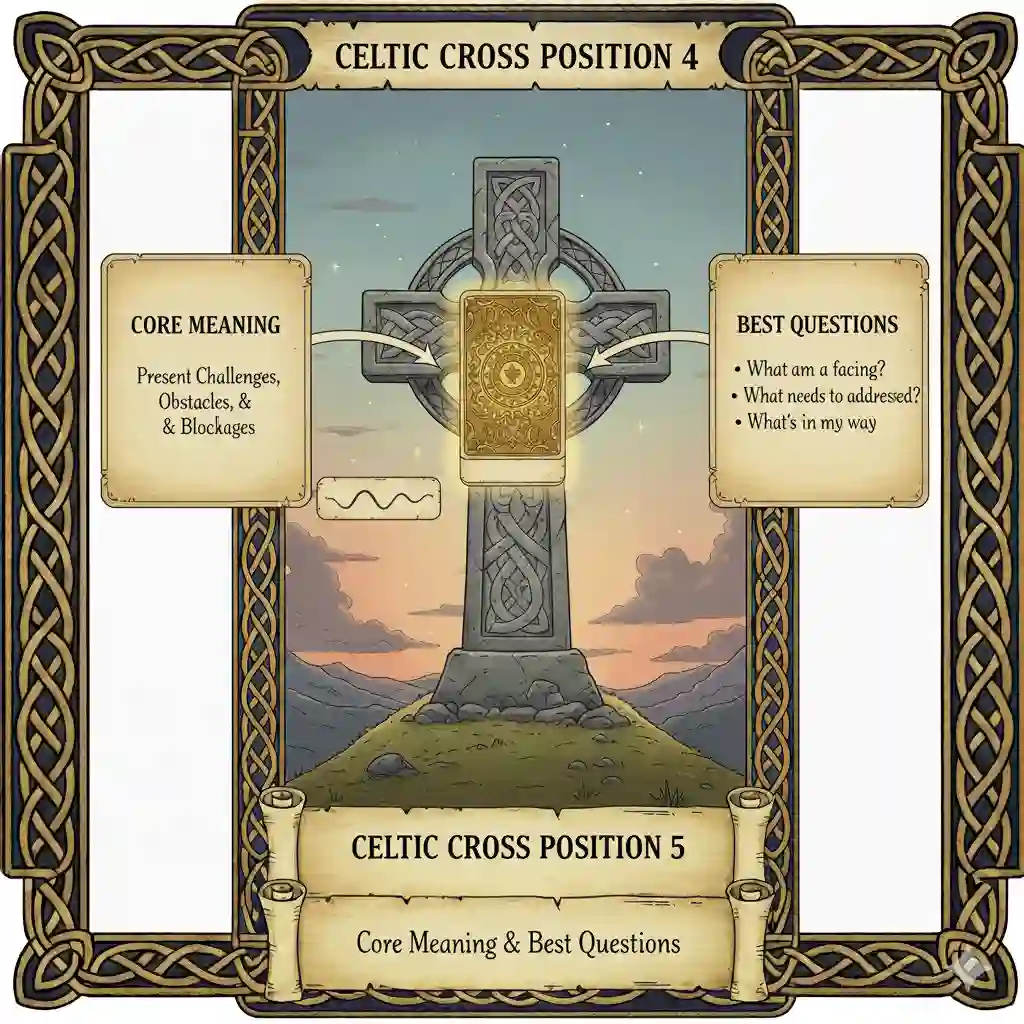
Position 5 of the Celtic Cross is one of the most direct yet frequently misunderstood placements in the entire spread. Situated directly above the central cross, it is often labeled as “hopes and fears” or simply “the future.” This ambiguity can lead readers astray. This position is not about a fated outcome or a vague wish; it is a clear window into the querent’s conscious mind. It reflects their current goals, plans, and the mental framework they are using to approach their situation. The key is understanding the difference between a hope, an intention, and a conscious aim. Position 5 is about the latter—it is the direction the querent is actively, consciously steering themselves toward. Common beginner mistakes include treating this card as the final outcome or reading it in isolation. This guide will teach you how to perform an accurate, layered interpretation of the Celtic Cross Position 5 meaning, moving beyond simple memorization to achieve true interpretive skill.
Table of Contents
- What Celtic Cross Position 5 Represents
- Position 5 vs Position 6 — Goal vs Near Future
- Upright Cards in Celtic Cross Position 5
- Reversed Cards in Celtic Cross Position 5
- How Position 5 Interacts with Other Celtic Cross Cards
- Best Questions to Ask for Celtic Cross Position 5
- Common Misinterpretations of Celtic Cross Position 5
- When Position 5 Shows Misaligned Goals
- Frequently Asked Questions (FAQ)
- Additional Questions
Before delving into specific card interpretations, we must first establish a solid conceptual foundation for this position. Understanding what Position 5 represents is the key to unlocking its powerful insights within a reading.
What Celtic Cross Position 5 Represents
At its core, Celtic Cross Position 5 represents conscious awareness. This is the card that answers the question, “What am I actively trying to achieve or make happen?” It reflects the querent’s present goals, aims, and intellectual approach to the situation at hand. Think of it as the mental blueprint or the strategy they are currently employing. This position reveals what the querent wants or expects to happen, which is a critical piece of information. It shows the direction of their willpower and focus. However, it is essential to remember the difference between desire and outcome. This card shows the target the querent is aiming for, but it does not guarantee they will hit it. Fully grasping this placement is a crucial step beyond just understanding the Celtic Cross foundation and into more nuanced, accurate readings.
Position 5 vs Position 6 — Goal vs Near Future
A common point of confusion is the relationship between Position 5 and Position 6. Position 5 is the conscious goal—what the querent intends to happen. Position 6, which sits to the right of the central cross, represents the near future—what is likely to happen if the current trajectory continues. Position 5 is about intention; Position 6 is about momentum. Reading them together provides a dynamic forecast. If they align (e.g., The Chariot in Position 5 and the Six of Wands in Position 6), the querent’s goal is well-supported and likely to be achieved. If they conflict (e.g., The Lovers in Position 5 and the Five of Cups in Position 6), it suggests the intended outcome may not unfold as hoped, pointing to potential disappointment or a need to adjust the plan.
The orientation of the card in this position—upright or reversed—provides immediate insight into the clarity and health of the querent’s goals. Let’s start by examining what an upright card signifies.
Upright Cards in Celtic Cross Position 5
When an upright card appears in the fifth position, it generally signals clear intentions and a healthy sense of ambition. The querent has a conscious and well-defined goal they are working toward. This placement suggests positive direction-setting and conscious motivation. The goal is likely aligned with their values and they are approaching it with a sense of purpose and clarity. For example, an upright Emperor in Position 5 shows a conscious goal of establishing structure, control, and stability. An upright Eight of Pentacles indicates a conscious focus on mastering a skill, committing to hard work, and improving through diligent effort. The key here is alignment; the querent knows what they want and their mental energy is directed cleanly toward that aim. An upright card in this position suggests that the goal itself is constructive and the querent’s approach to it is straightforward and intentional.
While upright cards show clear intentions, reversed cards introduce complexity. They often point to internal conflicts or misalignments that can sabotage the querent’s efforts, even at a conscious level.
Reversed Cards in Celtic Cross Position 5
A reversed card in Celtic Cross Position 5 offers a fascinating psychological insight. It often points to conflicting goals, conscious self-sabotage, or unrealistic expectations. The querent might say they want one thing, but their focus is clouded by fear, doubt, or external pressure. A reversed card here can represent a goal that is not truly what the soul wants, but what the ego thinks it should want. For instance, a reversed Ten of Cups in Position 5 could indicate a conscious goal of achieving a “perfect” family life, but this aim is driven by societal pressure or a fear of being alone rather than genuine desire. This leads to a feeling of strain and inauthenticity. Similarly, a reversed Star could show that while the querent hopes for healing, they are consciously stuck in pessimism or a belief that it is impossible. These are common interpretation mistakes in tarot spreads—failing to see the psychological tension a reversal can reveal. It highlights fear disguised as hope or pressure mistaken for ambition.
No card in the Celtic Cross should be read in a vacuum. Position 5 gains its full meaning when you analyze its relationship with the cards surrounding it, creating a rich narrative.
How Position 5 Interacts with Other Celtic Cross Cards
Understanding the dialogue between Position 5 and other key placements is crucial for a masterful reading. Each connection adds another layer of meaning.
- Position 1 (The Present Situation): The relationship between Position 5 and Position 1 shows how the querent’s goal relates to their current reality. If Position 1 is the Nine of Wands (defensive, weary) and Position 5 is The World (completion, integration), the querent is consciously aiming for closure, but they are approaching it from a place of exhaustion.
- Position 2 (The Challenge): This card often reveals what stands in the way of the goal in Position 5. If Position 5 is the Ace of Swords (a new idea, clarity) and Position 2 is the Four of Pentacles (resistance to change), the primary challenge to achieving that new clarity is a fear of letting go of what is known.
- Position 6 (The Near Future): As discussed, this shows the likely outcome of the conscious goal. If Position 5 is the Three of Cups (celebration, friendship) and Position 6 is the Hermit (solitude, introspection), it suggests the desire for connection may lead to a period of withdrawal, perhaps to re-evaluate what connection truly means.
- Position 7 (Self-Perception): This card, in the “Below” position, often reveals the subconscious belief driving the conscious goal in Position 5. If Position 5 is the King of Wands (visionary leadership) but Position 7 is the Five of Pentacles (insecurity, lack), the ambitious goal may be a conscious attempt to overcompensate for a deep-seated feeling of not having enough.
To get the most out of Position 5, you need to ask the right questions. Good questions help both the reader and querent drill down into the core of the matter, moving beyond surface-level interpretations.
Best Questions to Ask for Celtic Cross Position 5
Asking targeted questions can illuminate the nuances of the card in this position. Instead of a generic “What do I want?” these questions promote deeper self-reflection. They are designed to uncover the motivations, pressures, and beliefs shaping the querent’s conscious aims.
- What am I consciously aiming for right now?
- What is the primary goal that is guiding my decisions?
- What expectation is shaping my choices in this situation?
- Is this goal coming from a place of authenticity or from external pressure?
- What goal, if I achieve it, do I believe will solve my problem?
- Where might I be placing unnecessary pressure on myself?
- What does this goal say about what I value most right now?
- How is this conscious aim helping or hindering me?
- What might be a more aligned goal for me at this time?
- What fear could be disguised as this hope or ambition?
- What am I telling myself I should want?
- If I let go of this specific goal, what would I focus on instead?
These questions work because they treat Position 5 not as a passive wish, but as an active, conscious strategy that can be examined and, if necessary, adjusted.
Even with the best intentions, it’s easy to fall into common traps when interpreting this position. Recognizing these pitfalls is the first step toward avoiding them and providing a more accurate reading.
Common Misinterpretations of Celtic Cross Position 5
To refine your skills, it is vital to be aware of the most common ways this position is misread. Avoiding these interpretive traps will dramatically improve the clarity and accuracy of your Celtic Cross readings.
- Mistaking it for the Outcome: The most frequent error is seeing the card in Position 5 and declaring it the final result. This position is the intention, not the guaranteed future. The actual outcome is influenced by all ten cards, with Position 10 holding the most weight for the final word.
- Reading it as Fantasy Only: While this position can reflect hopes, it is more grounded than that. It is the conscious plan. Treating it as pure wishful thinking dismisses the querent’s active willpower and strategic mind, which are very real forces in the situation.
- Ignoring Context from Surrounding Cards: Reading Position 5 in isolation is like hearing one part of a sentence. A goal of the Four of Wands (stability, celebration) means something very different when the challenge (Position 2) is The Tower (sudden collapse) versus when it’s the Two of Cups (partnership).
- Overemphasizing Positivity or Fear: A reader might see a “good” card like The Sun and promise success, or a “scary” card like Death and predict doom. In this position, The Sun could be an unrealistic expectation of perfection, and Death could be a healthy and conscious goal of ending a chapter for good. The context is everything.
Sometimes, the story told by the cards reveals a significant gap between what the querent wants and what is actually healthy or possible for them. Position 5 is key to diagnosing this misalignment.
When Position 5 Shows Misaligned Goals
Position 5 is an excellent diagnostic tool for identifying when a querent’s goals are misaligned with their highest good. Certain cards in this position can signal unrealistic aims. For example, The Chariot reversed might indicate a goal that is being pursued with aggressive, uncontrolled force, destined for a crash. The Devil here could show a conscious goal that is rooted in addiction, materialism, or unhealthy attachment. It is important to distinguish between ego-driven goals (e.g., seeking fame, wealth, or control over others) and soul-driven goals (e.g., seeking peace, authenticity, or service). When you see a misalignment, gently guide the querent to question the why behind their goal. The solution is always to help them course-correct consciously, perhaps by re-evaluating what success truly means to them, as shown by the interaction with the rest of the spread.
Frequently Asked Questions (FAQ)
Is Position 5 the outcome in a Celtic Cross?
No, Position 5 is not the final outcome. It represents the querent’s conscious goal, aim, or intention. The near-future outcome is indicated by Position 6, and the longer-term or final outcome is most often represented by Position 10. Position 5 shows where the querent is aiming, not where they will land.
Can Position 5 show fears instead of hopes?
While its classic interpretation is “hopes,” it’s more accurate to say it shows “conscious focus.” Therefore, if a querent is obsessively focused on a fear, a card representing that fear can appear here. For example, the Nine of Swords in Position 5 might show that the querent’s conscious mind is completely preoccupied with anxiety, making that their de facto “goal” or mental state.
What if Position 5 conflicts with Position 6?
A conflict between Position 5 (the goal) and Position 6 (the near future) is a powerful message. It suggests that the current plan or intention is not leading to the desired result. It is a prompt to re-evaluate your strategy. For example, if you aim for partnership (The Lovers in 5) but are heading for solitude (The Hermit in 6), you must ask why your actions are creating isolation despite your goal.
Should reversals be read differently here?
Yes. In Position 5, a reversed card often points to an internal conflict regarding the goal. The goal may be unrealistic, inauthentic, blocked, or driven by fear and pressure rather than true desire. It is a sign that the querent’s conscious energy is scattered or misdirected concerning their aim.
How important is Position 5 in decision-making?
Position 5 is critically important in decision-making because it reveals your current strategy and mental framing. By understanding what you are consciously trying to achieve, you can assess whether that goal is realistic, healthy, and aligned with your deeper values. It gives you the power to consciously change your direction if needed.
What does a Major Arcana card mean in Position 5?
A Major Arcana card in Position 5 indicates that the conscious goal is tied to a significant life lesson or a major theme in the querent’s journey. The goal is not just a passing whim but something that is central to their spiritual and personal development at this time.
What if I get a confusing card like The Tower in Position 5?
A challenging card like The Tower in Position 5 suggests the querent may be consciously, or semi-consciously, aiming for a radical teardown of their current structures. They may feel a deep need to break free, even if it’s disruptive. It’s the goal of “burning it all down” to start fresh.
How does Position 5 relate to the subconscious (Position 7)?
Position 5 (conscious goal) sits directly on top of Position 7 (subconscious influences/self-perception). They are in direct dialogue. Often, the conscious goal in 5 is an attempt to either express or compensate for the subconscious energy in 7. For example, a subconscious feeling of powerlessness (Position 7) might lead to a conscious goal of extreme control (Position 5).
Can this position represent another person’s goals?
Typically, Position 5 reflects the querent’s own conscious goals. However, in a reading about a dynamic with another person, it could potentially reflect the goal the querent perceives the other person has, or a goal that is being heavily imposed upon the querent.
What’s the difference between this and Position 10 (Outcome)?
Position 5 is the intention at the beginning of the process. Position 10 is the synthesis of all the energies in the spread, representing the most likely final resolution or the key takeaway of the entire situation. The journey from 5 to 10 shows how an intention transforms as it meets challenges, influences, and its own underlying drivers.
Additional Questions
What is the definitive Celtic Cross Position 5 meaning?
The definitive Celtic Cross Position 5 meaning is the querent’s conscious goal, intention, or current mental focus. It represents what they are actively and knowingly trying to achieve or the expectation they hold about the future.
How does the Celtic Cross fifth position relate to conscious thought?
The fifth position is the primary seat of conscious thought in the spread’s vertical axis. It reveals the querent’s active strategy, plan, and what they are telling themselves about the situation, standing in contrast to the subconscious drivers shown in Position 7.
What does “Celtic Cross upper influence” mean for Position 5?
As the “upper influence,” Position 5 shows the ideal or goal that is “crowning” the present situation (Positions 1 and 2). It is the conscious thought-form that is presiding over the core issue, guiding the querent’s efforts and shaping their perception of a positive outcome.
Can you give a tarot spread interpretation guide for Position 5?
To interpret Position 5: First, identify the card’s core meaning as a goal. Second, note if it’s upright (clear goal) or reversed (conflicted goal). Third, compare it to Position 1 (the present) to see the starting point. Fourth, contrast it with Position 6 (near future) to see if the plan is on track. Finally, look at Position 7 (subconscious) to understand the hidden motivation behind the goal.
How do I read Celtic Cross hopes and intentions accurately?
To read hopes and intentions accurately, treat Position 5 less like a vague hope and more like a strategic aim. Ask not just “What do you hope for?” but “What are you actively doing or planning to do to make that happen?” This grounds the interpretation in the querent’s real-world agency.
What is the importance of the Celtic Cross future aim position?
The future aim position is vital because it reveals the querent’s current direction. Understanding the destination someone has plugged into their GPS is essential for advising them on the journey. It allows the reader to assess if the aim is helpful, realistic, and truly what the querent’s soul needs.
Conclusion
Ultimately, the Celtic Cross Position 5 meaning serves as a powerful mirror, reflecting the querent’s conscious will back at them. It is the compass needle of the reading, showing the direction of intention but not the nature of the territory ahead. Understanding this position is about embracing the critical difference between a conscious goal and an actual outcome. It reminds us that our plans and aims are potent forces that shape our journey, but they are not the journey itself. By encouraging a reflective and contextual reading of this placement, you can empower yourself or your querents to not only see where they are trying to go but to question if it is the right destination. This conscious inquiry is the first step toward true co-creation with the universe, a skill essential for anyone seeking to mastering the Celtic Cross tarot spread.