Fast Answer: What does the Nine of Swords mean for breakup anxiety?
The Nine of Swords appearing after a breakup signifies intense mental anxiety driven by thought loops, not an inescapable reality. This card reflects the way fear, guilt, and what-ifs become magnified in the isolation of the night, leading to sleeplessness and mental overactivity. The pain you are experiencing feels incredibly real, but it is not a permanent state or a prediction of the future. The Nine of Swords is a signal from your inner self to slow the mind and soothe the nervous system, not to analyze the past any further.
Introduction
In the quiet aftermath of a breakup, once the initial shock subsides, a different kind of pain can emerge. It arrives in the dead of night, a tormenting loop of memories, regrets, and fears that steal your sleep and peace. This is the domain of the Nine of Swords. When this card appears in a reading, it is a stark and honest reflection of profound mental suffering. It is the card of anxiety, sleeplessness, and the intrusive thoughts that can make you feel like you are losing your mind.
But it is crucial to understand what this card is truly saying. The Nine of Swords does not depict your fate; it depicts your current mental state. It is a mirror to the inner turmoil that occurs when the mind, desperate to regain a sense of control after a loss, begins replaying every scenario, every word, and every mistake. These intrusive thoughts are not intuition or a sign from the universe. They are the echoes of a nervous system in distress. This article is a guide to understanding this challenging energy. It is not about predicting the future but about finding relief in the present, calming the mental storm, and gently guiding you back to a place of rest.
Table of Contents
- Core Meaning of the Nine of Swords in Breakup Readings
- Why Breakups Trigger the Nine of Swords So Strongly
- Intrusive Thoughts vs Emotional Truth
- Sleeplessness, Night Anxiety & This Card
- Upright vs Reversed Nine of Swords After a Breakup
- What the Nine of Swords Is Not Saying
- What This Card Is Gently Asking You to Do
- When Tarot Can Increase Anxiety — and When to Pause
- FAQ Section — Nine of Swords & Breakup Anxiety
- Conclusion
Before you continue, take a gentle breath. Feel your feet on the floor. This moment is real. The thoughts are just visitors. Be present with your body as you read on.
Core Meaning of the Nine of Swords in Breakup Readings
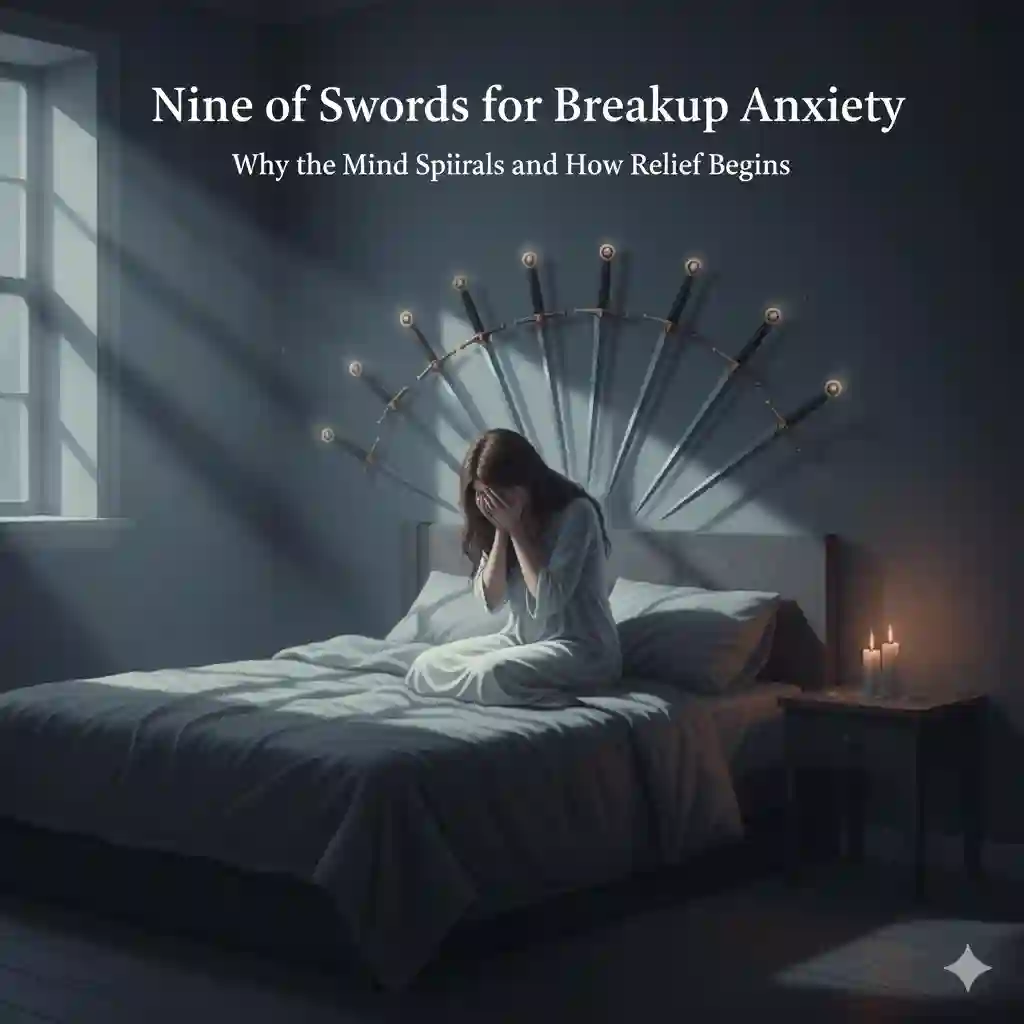
The Nine of Swords is often called the “nightmare card,” and for good reason. The traditional Rider-Waite artwork shows a figure sitting up in bed, head in hands, with nine swords hanging ominously on the dark wall behind them. This imagery perfectly captures the essence of mental anguish. The person isn’t physically wounded; their suffering is entirely internal, a product of their own thoughts.
In a breakup reading, this card points directly to the mental battlefield that your mind has become. It signifies that the pain you’re feeling is less about the emotional reality of grief and more about the stories your mind is telling you. This is the card of self-blame, where you endlessly replay conversations, wondering what you could have done differently. It’s the card of catastrophic thinking, where your mind leaps to the worst-possible future scenarios: “I will be alone forever,” “I will never get over this,” “I’ve ruined my only chance at happiness.”
The swords in the suit of Swords represent thoughts, intellect, and communication. Here, they are not being wielded; they are hanging on the wall, representing mental constructs and beliefs that have become a source of torment. This card shows a state of temporary mental overload, where your mind has turned against itself. It’s a sign that your brain is stuck in a loop, and the key to relief lies not in figuring out the puzzle, but in stepping away from it entirely.
“Nine of Swords tarot card meaning upright & reversed”
Pause here for a moment. Notice the tension in your shoulders or jaw. Gently release it. Your body is your anchor in this storm. Breathe into it.
Why Breakups Trigger the Nine of Swords So Strongly
A breakup is more than just an emotional event; it is a profound disruption to our sense of safety and attachment. This destabilization is what creates the perfect breeding ground for the anxiety of the Nine of Swords.
Loss of Attachment Safety
From a biological standpoint, our partners often become our primary attachment figures, the person we turn to for comfort and safety. When that person is gone, the nervous system can register their absence as a threat to survival. This triggers a state of hyper-vigilance, where the brain is on high alert for danger. Every small worry is amplified, and the mind starts spiraling to protect you from further harm, even if that harm is only imagined.
Fear of Abandonment and Regret
The Nine of Swords is deeply connected to core wounds of abandonment and regret. The breakup may have activated a deep-seated fear of being left, a fear that may have roots in your childhood or past experiences. Your mind, in an attempt to prevent this pain from ever happening again, begins to obsessively analyze what went wrong. It creates narratives of blame, guilt, and shame, believing that if it can just identify the “mistake,” it can control the future.
Why Silence Intensifies Thoughts
During the day, we have distractions—work, errands, conversations. These things keep our minds occupied. At night, in the silence and the dark, there is nothing left but you and your thoughts. Without external stimuli to ground you, the mental chatter gets louder. The nine swords on the wall become the only thing you can see, and the stories they represent feel like absolute truth.
Take another deep breath, in and out. Remind yourself that a thought is just a sentence in your head. It does not have to be your reality. You are safe in this moment.
Intrusive Thoughts vs Emotional Truth
One of the most difficult challenges of the Nine of Swords is learning to differentiate between an intrusive thought and a genuine emotional truth or intuition. Your anxiety feels real, so you believe what it tells you.
Thoughts as Stress Responses, Not Messages
An intrusive thought is an unwanted, often distressing thought or image that pops into your head. After a breakup, these can sound like, “They never really loved me,” or “I am completely unlovable.” It is vital to understand that these are not messages from your higher self or insights into reality. They are stress responses. They are your brain’s malfunctioning alarm system, ringing loudly because of the perceived threat of the breakup.
Why Anxiety Lies Convincingly
Anxiety is a powerful liar because it speaks with a voice of urgency and authority. It feels like intuition because it creates a strong physical sensation in your body—a racing heart, a knot in your stomach. However, true intuition is often quiet, calm, and clear. It feels like a deep “knowing,” not a panicked “what if.” The Nine of Swords represents the panic, not the knowing.
Separating Feeling from Fact
A helpful practice is to separate your feelings from the facts. The fact is: the relationship has ended. Your feeling is: “This means I am worthless.” The Nine of Swords asks you to acknowledge the feeling without accepting it as a fact. The tarot is mirroring your internal state of anxiety, not confirming that your anxious thoughts are true or predictive of a negative outcome.
Allow yourself a moment of stillness. Place a hand on your heart and feel its beat. This is the rhythm of life, continuing. You are more than your anxious thoughts.
Sleeplessness, Night Anxiety & This Card
The classic Nine of Swords experience happens at 3 a.m. The connection between this card and night anxiety is no coincidence; it’s rooted in our biology and psychology.
At night, our cortisol levels (the stress hormone) naturally dip to allow for rest. However, when you are in a state of acute stress from a breakup, your cortisol can remain elevated, leading to a “tired but wired” feeling. You’re exhausted, but your mind won’t shut off. This physiological state is the engine of the Nine of Swords.
The lack of distraction is the other key factor. During the day, you can push thoughts away. At night, you are a captive audience to your own mind. The darkness and silence create an echo chamber where every fear and regret reverberates, growing louder and more menacing with each loop. The Nine of Swords is a perfect depiction of this state: alone in the dark, trapped by the swords of your own creation. Normalizing this experience is the first step toward relief. It is incredibly common to experience insomnia after a significant loss. You are not broken; your system is simply overloaded.
Breathe in calm, breathe out noise. Your mind is a sky, and thoughts are just clouds passing through. You are the sky, not the clouds.
Upright vs Reversed Nine of Swords After a Breakup
The orientation of the card can offer insight into the stage of your anxiety and the path toward healing.
Upright: Active Rumination and Panic Cycles
When the Nine of Swords appears upright, you are in the thick of it. You are actively caught in the cycle of rumination, intrusive thoughts, and sleepless nights. The pain is acute, and you may feel completely powerless against the onslaught of your own mind. This is the stage of identifying the problem. The card is showing you, “Here, this is the source of your suffering. It is in your mind.” It validates your pain without sentencing you to it forever.
Reversed: Beginning to Release Fear, Seeking Help
A reversed Nine of Swords is often a sign of hope. It can indicate that you are beginning to release the worst of the anxiety. You may be starting to question your negative thoughts, realizing that they are not the absolute truth. This is often the point where you begin to seek help, whether by talking to a friend, seeking therapy, or actively using grounding techniques to calm your mind. The swords are still there, but they are losing their power. Relief is not always a sudden floodlight; sometimes, it is the slow, gentle dawn of the reversed Nine of Swords.
Be gentle with yourself. This is not a test of your strength. It is an invitation to practice compassion for your own hurting mind.
What the Nine of Swords Is Not Saying
To escape the prison of the Nine of Swords, you must understand what it is not telling you. Your anxious mind will try to convince you of the worst, but the card itself carries no such prophecy.
It Is Not a Prediction of Being Alone Forever
This card is a snapshot of your current mental state. It has zero predictive power over your future love life. It is about the pain you are in now, not the pain you are destined for.
It Is Not Punishment or Karma
The Nine of Swords is not a sign that you are being punished for past mistakes. It is a psychological response to loss and stress. Do not add a layer of spiritual guilt to the mental anguish you are already feeling.
It Is Not Proof You Made a Mistake
Your mind may use this intense anxiety as “proof” that the breakup was a mistake and you should go back. This is a common cognitive trap. The anxiety is a symptom of the withdrawal from the attachment, not a sign that the relationship was your only source of happiness.
It Is Not Intuition Demanding Action
The panicked energy of this card is not intuition telling you to text your ex or check their social media. In fact, acting on these anxious impulses will almost always make the Nine of Swords energy worse. This card is asking for stillness, not frantic action.
Place your hand on your stomach and breathe deeply into it. Feel the rise and fall. You are anchoring yourself back into your body, away from the chaos of the mind.
What This Card Is Gently Asking You to Do
The Nine of Swords feels like a crisis, but it contains its own medicine. It is asking you not to fight harder, but to soften and soothe.
Reduce Stimulation and Analysis
Your mind is overworked. Stop giving it more to do. This means no more re-reading old texts, no more stalking social media, and no more asking for endless tarot readings about the situation. You cannot think your way out of a problem that is being caused by thinking.
Interrupt Thought Spirals with Grounding
When you feel the spiral begin, interrupt it physically. Get out of bed. Splash cold water on your face. Name five things you can see, four you can feel, three you can hear, two you can smell, and one you can taste. This is the 5-4-3-2-1 grounding technique, and it pulls your awareness out of your head and back into your body and the present moment.
Seek Reassurance and Support
The figure in the card is alone. The antidote is connection. Talk to a trusted friend or family member. Say the scary thoughts out loud to someone who can lovingly tell you, “I hear your fear, but that is not the truth.”
Prioritize Sleep and Nervous-System Care
Do whatever it takes to help your body rest. This might mean sleep meditations, a warm bath before bed, or a cup of chamomile tea. Prioritizing your nervous system is not an indulgence; it is the most critical work you can do right now.
Remember, it’s okay to step away. Tarot is a tool for clarity, not a new source of anxiety. If it’s causing more pain, it’s time to pause.
When Tarot Can Increase Anxiety — and When to Pause
For someone in a Nine of Swords state, tarot can be a double-edged sword. While it can offer profound insight, it can also become another tool for obsessive analysis.
Signs of Tarot-Induced Rumination
If you find yourself pulling cards multiple times a day about the same situation, frantically looking for a different answer, you are using tarot to fuel your anxiety, not soothe it. If every card you pull seems to confirm your worst fears, it’s likely that your own panicked energy is influencing the reading. You are not getting a clear message; you are getting an echo of your own fear.
Why Breaks Can Help Integration
Sometimes the most spiritual thing you can do is put the cards away. Taking a break for a few days or even weeks allows the energy to settle. It gives you time to integrate the original message and to live in the real world, rather than in a world of symbolic interpretation.
Returning to Readings from a Calmer State
When you feel your nervous system has calmed and you can approach the cards with curiosity rather than desperation, that is the time to return. A reading from a grounded state will offer true guidance and clarity, not just a reflection of your momentary panic.
FAQ Section — Nine of Swords & Breakup Anxiety
Does this card mean I’ll never feel okay?
Absolutely not. The Nine of Swords represents a temporary but acute state of mental distress. It is a sign of how much pain you are in right now, not a life sentence. Healing from this is not only possible, it is the natural course of things. The intensity of this card shows a peak of anxiety, and after a peak, there is always a descent.
Is my anxiety intuition about reconciliation?
It is highly unlikely. The panicked, looping, and catastrophic nature of Nine of Swords anxiety is the opposite of calm, clear intuition. This anxiety is a symptom of attachment withdrawal and the fear of loss. It is your nervous system screaming for the familiar, not your higher self telling you to go back.
Why do I panic more at night?
Our minds are less defended at night. Without the distractions of the day, our brains are free to focus on unresolved emotional issues. Biologically, shifts in hormones like cortisol can also make us more susceptible to anxiety during the late-night and early-morning hours. This is an extremely common experience and not a sign that you are losing control.
Should I reach out to stop the anxiety?
This is rarely a good idea. Reaching out from a place of Nine of Swords panic is an attempt to use your ex to soothe your anxiety. It puts you in a disempowered position and often leads to more pain and confusion. The work of this card is to learn how to self-soothe and find your center without external validation.
Does the Nine of Swords mean guilt?
Guilt and regret are major themes of this card. You may be torturing yourself over things you did or said, or things you wish you had done differently. The card asks you to recognize these are just thoughts. You cannot change the past by mentally punishing yourself in the present. The path to relief is through self-forgiveness, not self-flagellation.
Can this card indicate regret?
Yes, intense regret is a hallmark of the Nine of Swords. The mind becomes obsessed with “what if” scenarios. It’s important to see this regret as a symptom of the anxiety itself. Instead of getting lost in the specifics of the regret, focus on calming the underlying anxiety that is fueling it.
How long does this phase last?
There is no set timeline, as it depends on your unique situation and your coping mechanisms. For some, the acute phase might last a few days or weeks. The key is to take proactive steps to soothe your nervous system. The more you engage in grounding, self-compassion, and getting support, the more quickly you will move through this intense energy.
Is it normal to obsess after a breakup?
Yes, it is very normal. A breakup is a significant life stressor, and obsession (rumination) is a common trauma response. Your brain is trying to make sense of the pain and regain control. While it’s normal, it’s not helpful, and the goal is to gently guide your mind toward more productive paths of healing.
Can tarot help anxiety or worsen it?
It can do both. When used as a tool for self-reflection from a relatively calm space, tarot can provide incredible comfort and guidance. When used as a tool for frantic fortune-telling to escape anxiety, it will almost always make it worse by feeding the obsessive cycle. The key is your intention and emotional state when you approach the cards.
What helps calm this energy?
Grounding techniques are paramount. Focus on your physical senses. Practice deep, slow breathing. Limit caffeine and screen time, especially before bed. Engage in gentle movement like walking or stretching. Most importantly, practice self-compassion. Speak to yourself as you would a dear friend who is suffering.
Additional Semantic Questions
Can this card indicate a trauma response?
Yes, the Nine of Swords is a classic depiction of an acute stress or trauma response, where the mind is stuck in a loop of hyper-vigilance and fear.
Is anxiety part of grief?
Anxiety is a very common and normal component of the grieving process. Grief isn’t just sadness; it can include anger, confusion, and a profound sense of anxiety as you adjust to a new reality.
Does this card suggest healing is possible?
Implicitly, yes. By so accurately diagnosing the problem (mental anguish), the card points toward the solution: calming the mind. Recognizing the problem is always the first step to healing it.
What if I feel mentally exhausted but not sad?
This is a perfect description of Nine of Swords energy. It’s less about emotional weeping (which is more the realm of Cups) and more about mental burnout from constant worry and overthinking.
Conclusion
The Nine of Swords feels like an endless night of the soul, a private torment from which there is no escape. Yet, its appearance in your reading is, in itself, an act of grace. It is a mirror held up to your mind, showing you with perfect clarity that your suffering is real, valid, and—most importantly—generated by thought. It is not your destiny. It is not your forever. It is a storm cloud, not the entire sky.
To heal from this card is to learn the profound art of self-compassion. It is to accept that your mind, in its attempt to protect you, has become your tormentor. The path forward is not to fight the thoughts, but to let them go. You do this by turning your attention away from the mental chaos and toward the physical reality of your body, your breath, and the ground beneath your feet. Prioritize rest, seek comfort, and be radically gentle with yourself. The swords will come down from the wall, the dawn will break, and you will sleep again.