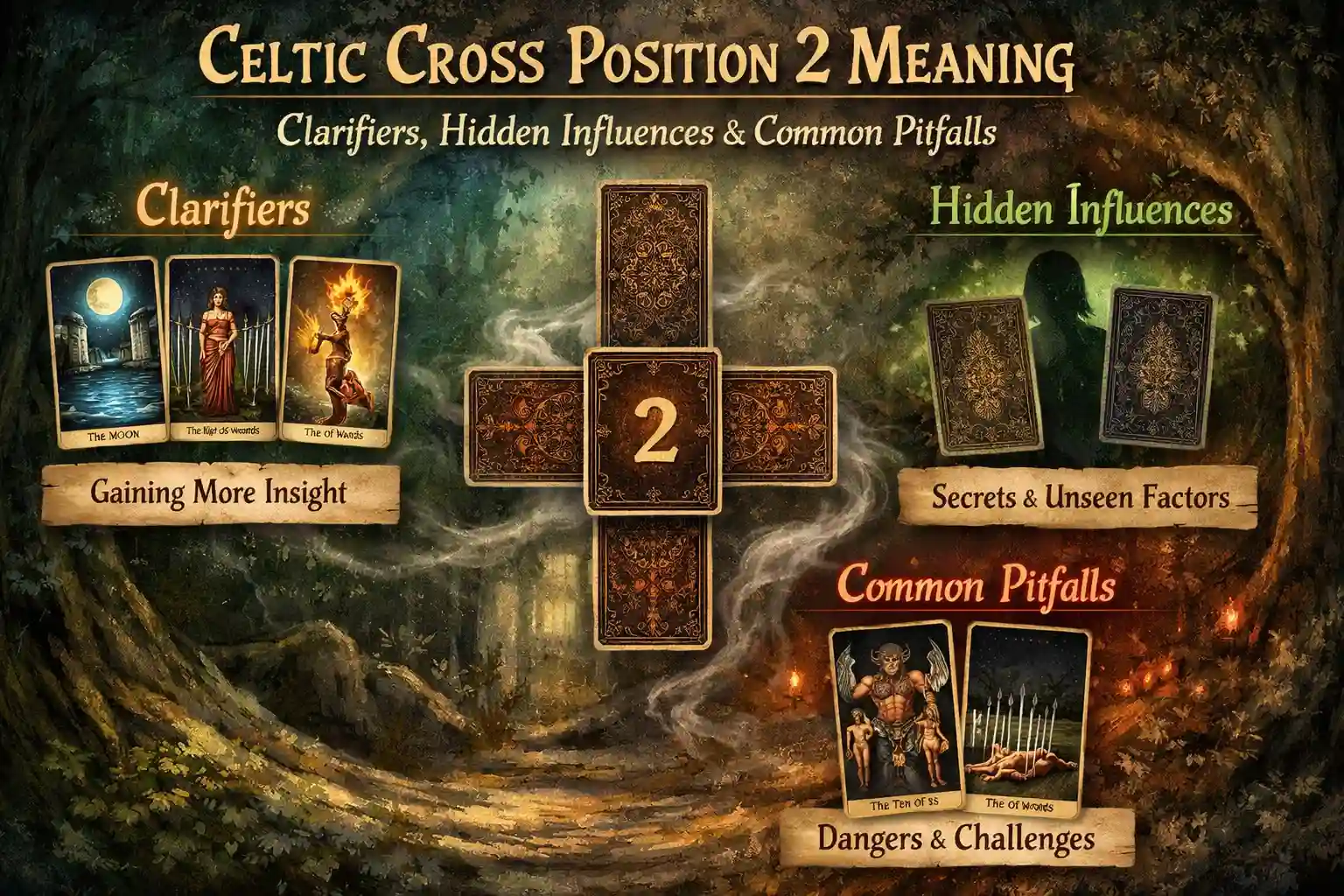
Celtic Cross Position 2 Meaning — Clarifiers, Hidden Influences & Common Pitfalls
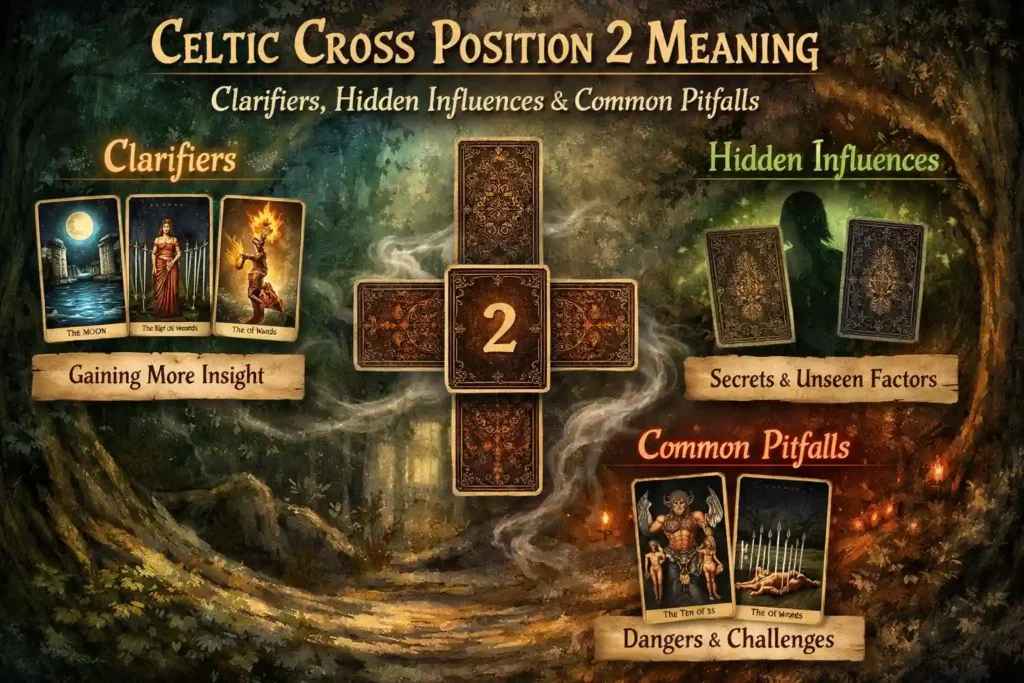
Celtic Cross Position 2 represents the card that directly interacts with or “crosses” the central issue found in Position 1. Often called the challenge, this position reveals hidden obstacles, sources of conflict, or even supportive reinforcements. Its interpretation depends entirely on the context of the reading, as it can clarify, amplify, or block the energy of the core situation. Understanding this crossing card is not about seeing a problem, but about recognizing the most immediate force that must be addressed to move forward.
The second position of the Celtic Cross is frequently misunderstood, often simplified to just “the obstacle.” This narrow view robs the reading of its depth. Early tarot traditions saw this crossing card as a more dynamic influence—one that could complicate, clarify, or even energize the central theme. It does not always represent a problem to be solved; it can just as easily be a reinforcing energy that strengthens Position 1 or a neutral factor that adds a necessary layer of complexity. Discerning whether this card challenges or supports the core issue is a skill that separates novice readers from seasoned practitioners. This guide offers the most detailed explanation of Celtic Cross Position 2 available, exploring its role as a clarifier, a hidden influence, and a source of common interpretive pitfalls.
Table of Contents
- Core Meaning of Celtic Cross Position 2
- Position 2 as a Clarifier — When It Supports Rather Than Blocks
- Common Pitfalls Reading Celtic Cross Position 2
- Major vs Minor Arcana in Position 2
- Upright vs Reversed Cards in Position 2
- How Position 2 Shapes the Spread’s Tone
- Position 2 Across Love, Career, & Spiritual Readings
- Practical Advice for Reading Position 2
- Position 2 as a Message From the Spread
- Frequently Asked Questions — Celtic Cross Position 2
- Conclusion
To move beyond a surface-level reading, we must first understand the fundamental role of this crossing card. The following section breaks down its core function as the primary modifying influence in the spread.
Core Meaning of Celtic Cross Position 2
Position 2 is the crossing influence, representing the most immediate and direct energy impacting the heart of the matter (Position 1). It is not a separate event but is intrinsically linked to the central theme, acting to modify, challenge, or clarify it. This influence can manifest as an internal obstacle, like a limiting belief, or an external one, such as a competing priority or another person’s agenda. The crossing can be resistant, creating friction and conflict, or it can be supportive, providing a necessary tension that encourages growth. The most critical rule for interpretation is to always read Position 1 and Position 2 together as a pair. Their interaction tells the story of the central dynamic at play, a concept explored further in the Celtic Cross Position 1 explained guide.
While this position is famous for being a challenge, its role as a clarifier is equally important. Understanding when it helps rather than hinders is key to an accurate reading.
Position 2 as a Clarifier — When It Supports Rather Than Blocks
Sometimes, the energy in Position 2 is clarifying rather than obstructive. Instead of blocking the core issue, it reinforces or illuminates it. This often happens when the two cards share a suit, a number, or a common theme. For example, if The Chariot is in Position 1 (forward motion) and the Eight of Wands crosses it (speed, messages), the second card is not an obstacle. It is a clarifier, amplifying the theme of rapid progress. Even a neutral or positive card can still “cross” the situation by introducing a necessary focus. The Two of Pentacles in Position 2 might challenge a scattered mind by demanding balance and prioritization, which is a supportive action. Interpreting Position 2 correctly strengthens your insight by revealing how all energies are contributing to the situation, not just the negative ones.
Misinterpreting this nuanced position is one of the most frequent errors in tarot reading. Let’s explore the common pitfalls to help you avoid them.
Common Pitfalls Reading Celtic Cross Position 2
Several common mistakes can lead to an inaccurate reading of Position 2. The most frequent is automatically assuming the card is negative, which blinds you to its potential as a supportive clarifier. For instance, seeing the Six of Cups (nostalgia) as a challenge might be correct, but it could also be clarifying that the past is the key to the present situation. Another major pitfall is reading Position 2 in isolation, forgetting its job is to modify Position 1. Ignoring this interaction is like reading a single word without its sentence. Readers also tend to overemphasize Position 2, making the challenge seem bigger than the core issue itself. Finally, projecting personal bias onto the crossing card—especially a “scary” one like Death or The Devil—can distort the message from one of transformation or attachment into one of pure fear.
The type of card that falls in this position also dramatically changes its weight and meaning. Understanding the difference between Major and Minor Arcana here is essential.
Major vs Minor Arcana in Position 2
When a Major Arcana card appears in Position 2, it signals that the crossing influence is a significant life lesson or a karmic pattern. This is not a fleeting issue but a foundational theme that is demanding your attention. For example, The Hermit crossing your situation points to a deep, soul-level need for introspection. In contrast, a Minor Arcana card typically represents a more temporary, situational influence. It reflects a current mood, a passing event, or a specific action. The Five of Swords here suggests a temporary conflict or a battle of egos, which is difficult but likely not a life-altering karmic block. The intensity of a Major Arcana influence in tarot spreads means these crossings deserve closer examination, as they often hold the key to the entire reading.
The orientation of the card—upright or reversed—adds another layer of complexity to the interpretation.
Upright vs Reversed Cards in Position 2
The orientation of the card in Position 2 provides clues about how the crossing energy is being expressed. An upright card often represents a clear, active, and externalized influence. The obstacle or support is straightforward and easily identified. A reversed card, however, frequently points to internal blocks, delays, or misaligned energy. The challenge is coming from within—perhaps from a subconscious belief, a repressed feeling, or an inability to access the card’s positive qualities. Reversals can intensify the complexity of the situation, suggesting that the path forward requires inner work before external action. As always, context is key; a reversal is not inherently “worse,” but it does signal that the energy is not flowing freely.
The dynamic between the first two cards sets the energetic mood for the entire spread. Let’s look at how this interaction shapes the overall tone of the reading.
How Position 2 Shapes the Spread’s Tone
The relationship between Position 1 and Position 2 establishes the central tension or flow of the reading. A harmonious pairing (e.g., two cards from the same suit) suggests a more straightforward path, while a conflicting one (e.g., a Sword crossing a Cup) points to significant friction between thought and emotion. This initial interaction can redirect the focus of the entire reading. A powerful Major Arcana in Position 2 might signal that a seemingly mundane question has deeper spiritual implications. Experienced readers prioritize this pairing because it dictates the emotional and situational tone, revealing whether the journey ahead will be one of struggle, synergy, conscious effort, or unexpected grace.
This dynamic plays out differently across various areas of life. Here are a few examples of how to interpret Position 2 in specific contexts.
Position 2 Across Love, Career, & Spiritual Readings
In love readings, Position 2 often reveals hidden tension or emotional resistance. The Moon crossing The Lovers could signify that unacknowledged fears or secrets are challenging a partnership. In a career context, this position can represent a tangible obstacle, a competing opportunity, or external pressure. The Ten of Wands crossing the Ace of Pentacles might indicate that burnout is threatening a new financial opportunity. For spiritual questions, Position 2 frequently highlights a conflict between intuition and ego. The Knight of Swords crossing the High Priestess could symbolize a tendency to rush forward with logic, overriding your inner knowing.
With these concepts in mind, here is some actionable advice to help you read Position 2 with greater confidence and accuracy.
Practical Advice for Reading Position 2
To master this position, integrate these practices into your readings. First, always interpret Position 2 in direct conversation with Position 1—they are a pair. Look for overlaps in suits, numbers, or themes that might indicate a clarifying energy. If a card feels ambiguous, don’t hesitate to ask a clarifying question or even pull an extra card for more detail. Most importantly, avoid rigid, obstacle-only thinking and stay open to the possibility of supportive tension. As you read, take note of the narrative flow. Does the crossing card stop the story, or does it add a twist that makes it more interesting?
Ultimately, this position is not a judgment but a message. Understanding its purpose is the final step in leveraging its power.
Position 2 as a Message From the Spread
Position 2 serves as a critical message from the spread, providing awareness before you take action. It is the tarot’s way of saying, “Pay attention to this.” The tension it creates is not meant to defeat you but to reveal a lesson that is crucial for your growth. By understanding the nature of the crossing energy, you can navigate the situation with intention rather than reacting blindly. It transforms an unconscious obstacle into a conscious choice, allowing you to engage with the challenge in a way that fosters wisdom and empowerment.
Frequently Asked Questions — Celtic Cross Position 2
Is Position 2 always negative?
No, it is not always negative. While it often highlights a challenge, it can also act as a supportive clarifier or introduce a necessary tension for growth. Its meaning is defined by its interaction with Position 1, not by a rigid “negative” label.
Can Position 2 be supportive?
Absolutely. A card in Position 2 can be supportive by reinforcing the theme of Position 1, adding clarifying details, or presenting an opportunity that challenges you to grow in a positive way. For example, a promotion (The Emperor) can be a “challenge” to your comfort zone.
What if Position 2 contradicts Position 1?
When the cards contradict, it signifies a major point of conflict or a “cross-purpose” energy. This is the heart of the reading’s tension. For example, a card of action crossing a card of passivity shows a conflict between the desire to move and the inability to do so.
Should Position 2 outweigh Position 1?
Position 2 does not outweigh Position 1, but it directly influences it. Position 1 is the subject of the sentence, and Position 2 is the verb that acts upon it. Its influence is powerful and immediate, but it cannot be understood without the context of the core issue.
How do reversals affect Position 2?
Reversals in Position 2 often suggest the challenge is internal, blocked, or not being expressed constructively. It may point to self-sabotage, a lack of awareness, or a need to address the issue on a subconscious level before it can be resolved externally.
What if the same suit appears in both positions?
When the same suit appears in Positions 1 and 2, it typically acts as a powerful clarifier. The energy is consistent and focused. This reinforces the central theme, suggesting the challenge and the situation are rooted in the same elemental energy (e.g., thoughts for Swords, emotions for Cups).
Can Position 2 represent another person?
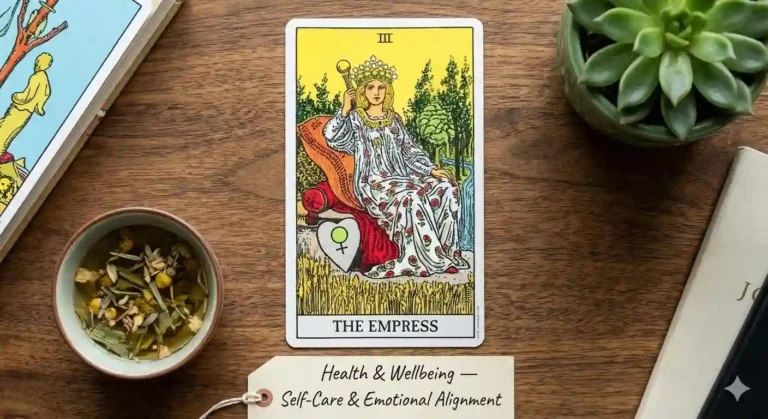
Yes, frequently. Court Cards in this position often signify a person whose actions or personality are directly influencing the situation. Even other cards can represent the energy of another person, such as The Empress representing a mother figure’s influence.
Is Position 2 internal or external?
It can be either. A reversed card or a card like The Hermit or The Moon often points to an internal challenge. A card like The Tower, the Five of Wands, or a Court Card is more likely to represent an external event or person. The context of the reading will help you decide.
Why does Position 2 confuse beginners?
Beginners are often taught that Position 2 is simply “the obstacle,” which is an oversimplification. This rigid definition makes it difficult to interpret positive or neutral cards in this position, leading to confusion and inaccurate readings.
Can I clarify Position 2 with extra cards?
Yes. If the meaning of the crossing card is unclear, pulling one or two clarifying cards is an excellent technique. Ask, “In what way is this card a challenge?” or “What aspect of this card should I focus on?” to gain more specific insight.
Conclusion
The importance of Celtic Cross Position 2 cannot be overstated. It is far more than a simple obstacle; it is the dynamic, crossing influence that brings the reading to life. By moving beyond fear-based interpretations and embracing its potential as a clarifier, you unlock a deeper layer of meaning. True mastery comes from observing the intricate dance between Position 1 and Position 2, allowing their interaction to reveal the central lesson at the heart of the question. With this awareness, you are empowered to navigate the challenges and opportunities ahead with clarity and purpose. Now, you are ready to explore the rest of the spread with the Complete Celtic Cross tarot spread guide.