Fast Answer: Death vs Tower vs Judgement as Feelings
When these three powerful Major Arcana cards appear in a reading about feelings, they signal profound emotional transformation. While often feared, they are not inherently negative. They simply describe different stages of a necessary process of change.
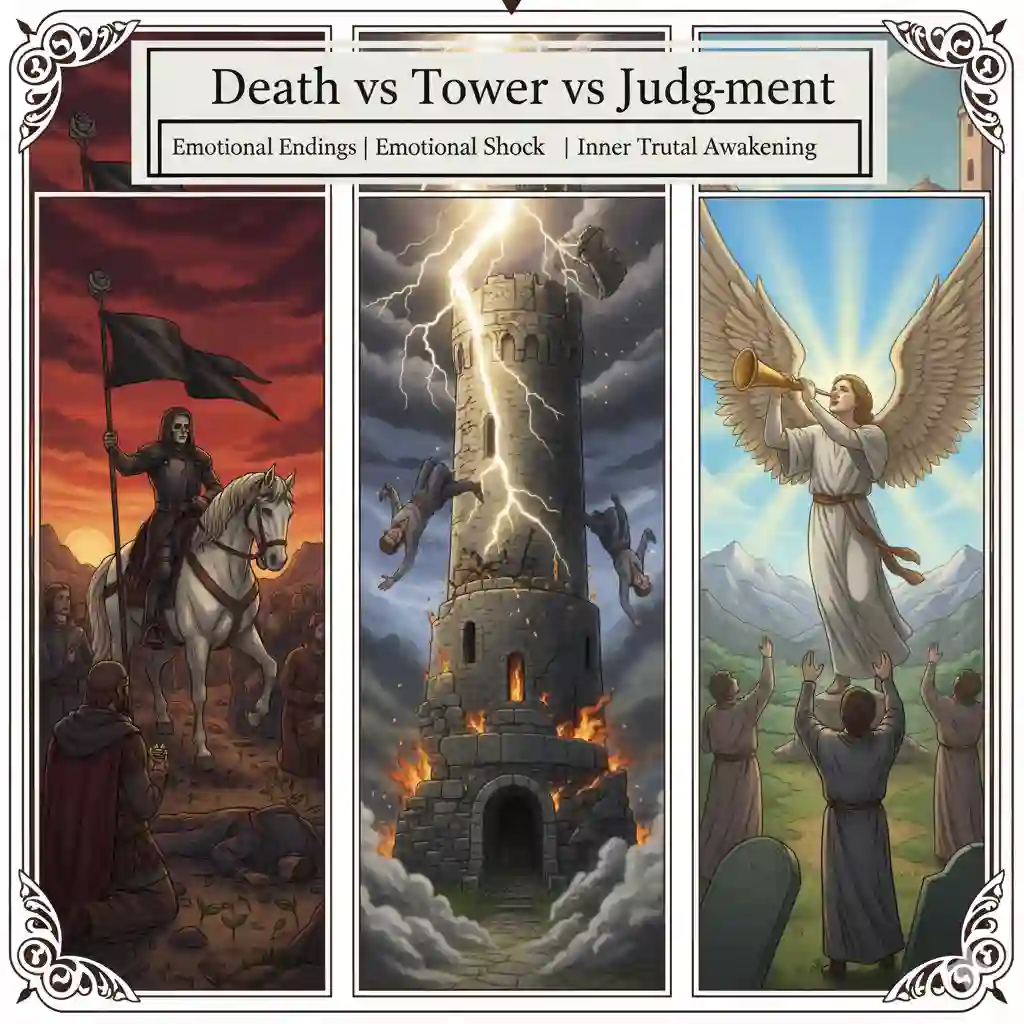
- Death as feelings = emotional closure and irreversible inner truth. This is the feeling of a natural, often quiet ending. The emotional cycle has completed, and there is no desire to go back. It is the peace of finality.
- The Tower as feelings = emotional shock, collapse, or forced realization. This is the feeling of a sudden, often jarring revelation. Illusions are shattered, and a truth that has been ignored is forcibly brought to light. It is the pain of a necessary crisis.
- Judgement as feelings = emotional awakening, reckoning, and rebirth. This is the feeling of clarity and integration after the chaos. It involves self-forgiveness, accountability, and the conscious choice to move forward with newfound wisdom. It is the resurrection of the authentic self.
Critically, these cards describe internal emotional processes, not literal external events. They often appear together or in sequence, mapping out a journey of profound emotional change from which there is no return, only rebirth.
Why These Three Cards Are Often Confused Emotionally
Death, The Tower, and Judgement are arguably the most feared cards in the tarot deck. Their dramatic names and imagery evoke feelings of dread, loss, and punishment. When they appear in a reading about love and emotions, it’s easy to jump to worst-case scenarios: a devastating breakup, a painful betrayal, or a final, harsh verdict. However, this interpretation misses the psychological and spiritual depth these cards offer.
The confusion arises because we often mistake intensity for negativity. All three cards are intense, but they describe the essential, and often uncomfortable, process of emotional evolution. We fear them because we fear change, especially when it is profound and irreversible. We mistake the ego’s resistance to being dismantled for a sign that something terrible is happening. In reality, these cards signal that something inauthentic is ending so that something true can emerge.
This article will demystify the death vs tower vs judgement feelings dynamic by exploring each card’s unique emotional signature. We will differentiate emotional endings (Death) from emotional breakdowns (The Tower) and emotional awakenings (Judgement), providing a calm, clear framework for understanding your own journey of transformation.
Death as Feelings – Emotional Closure & Completion
The Death card, stripped of all sensationalism, represents the feeling of a natural, necessary, and often peaceful ending. It is the quiet exhalation when a long struggle is finally over. Unlike the sudden crash of The Tower, Death is often a slow, organic process, like leaves falling in autumn. By the time the card appears, the ending has likely already happened on an internal level.
Emotional Truth That Can No Longer Be Negotiated
The core feeling of the Death card is finality. It is the moment you wake up and realize you are no longer in love, no longer angry, or no longer hoping for a different outcome. This is an emotional truth that cannot be argued with or bargained away. It is not a decision, but a realization. The emotional energy that once fueled the connection has simply dissipated.
Inner Detachment Without Resentment
A key aspect of the Death as feelings meaning is the absence of strong negative emotion. While there may be sadness, there is typically no active hatred, bitterness, or rage. These are still forms of connection. Death signifies a true severing of the emotional cord. The feeling is one of neutral detachment, a calm acceptance that a chapter has closed.
Completion Rather Than Destruction
Death is about completion, not destruction. It signals that a particular emotional lesson has been learned or a soul contract has been fulfilled. The relationship has served its purpose and is now complete. The feeling is less about something being taken away and more about something having reached its natural conclusion.
Peaceful Endings vs Avoidance
The peace of the Death card should not be confused with avoidance. Avoidance is an act of fear. The calm of Death is an act of courage—the courage to look at the truth without flinching and to accept it without drama. It is the quiet dignity of letting go.
The Tower as Feelings – Emotional Shock & Collapse
If Death is the quiet sunset, The Tower is the lightning strike. It represents a sudden, shocking, and often painful emotional realization. The Tower appears when we have been living in a structure built on a false foundation—a lie, a denial, an illusion. The feelings associated with this card are the crisis and collapse that occur when that structure is demolished.
Sudden Emotional Realizations
The Tower signifies a moment of brutal honesty. It is the feeling of the blinders being ripped off. This could be discovering a betrayal, realizing a fundamental incompatibility, or having a truth you’ve been denying about yourself or your partner become undeniably clear. The shock comes from the speed and force of the revelation.
Emotional Structures Breaking Down
We all build emotional structures: belief systems about love, identities within relationships, and expectations for the future. The Tower represents the feeling of these structures collapsing. There is a sense of disorientation, of the ground giving way beneath you. It is the feeling of, “Everything I thought was true, isn’t.”
Loss of Illusion, Not Loss of Self
Critically, The Tower destroys what is false, not what is real. The feeling is one of losing a cherished illusion, which can be incredibly painful. However, it is not the loss of your true self. The pain of The Tower as feelings meaning is the pain of liberation from a prison you may not have even known you were in.
Panic, Grief, or Emotional Disorientation
The immediate emotional aftermath of The Tower is often chaos. Panic, intense grief, confusion, and a sense of being emotionally homeless are common. It is a crisis state. The key is to understand that this crisis is not a punishment, but a necessary clearing of a toxic or unsustainable emotional foundation. It is a painful but ultimately healing event.
Judgement as Feelings – Emotional Awakening & Reckoning
After the quiet ending of Death and the chaotic collapse of The Tower, Judgement appears. It is the card of emotional resurrection. This is the stage of processing, integration, and rebirth. It is not about being judged by an external force, but about a deep, internal reckoning with the self.
Emotional Clarity After Chaos
The core feeling of Judgement is clarity. After the storm of The Tower, the air is clean. You can see everything—your role, their role, the lessons, the pain—with a new, higher perspective. The emotional charge is gone, replaced by a profound understanding.
Forgiveness, Accountability, and Self-Truth
Judgement involves a process of reckoning. This often manifests as feelings of forgiveness—both for the other person and, more importantly, for yourself. It is about taking accountability for your part in the dynamic without blame or shame. It is the feeling of standing in your own truth, finally free from the narratives of the past.
Rebirth After Processing
This card signifies the end of the grieving process and the beginning of a new life. The feeling is one of awakening, of coming back to yourself after a long period of being lost. It is the urge to live again, but differently. You have integrated the lessons of the past, and you are ready to make a conscious choice about your future. This is the essence of emotional rebirth tarot.
Conscious Choice Rather Than Reaction
Unlike the reactive state of The Tower, the feelings of Judgement are conscious and deliberate. It is the moment where you are presented with a choice: Do I repeat the cycle, or do I answer the call to evolve? The feeling is one of empowerment, knowing that you are at the helm of your own emotional destiny. The Judgement emotional awakening is about choosing your next chapter.
Emotional Timeline: How These Cards Appear Sequentially
While these cards can appear individually, they often map out a powerful sequence of emotional transformation. Understanding this timeline can provide a roadmap for your own healing journey.
- Stage 1: Death – The Internal Ending. Long before any external drama, something quietly ends inside. A feeling shifts, a decision is made subconsciously, or the energy of a connection simply runs out. This is the quiet knowledge that it’s over, even if nothing has happened yet.
- Stage 2: The Tower – The External Realignment. Reality catches up. An event occurs—a conversation, a discovery, a choice—that shatters the external structure that was no longer aligned with the internal truth of Death. This is the crisis that forces the outside world to match the inside world.
- Stage 3: Judgement – The Conscious Integration. After the collapse, there is a period of reflection. You survey the wreckage and begin to understand why it had to fall. You integrate the lessons, forgive yourself and others, and consciously choose how to move forward. This is the moment you answer the call to your new life.
Sometimes, these cards can appear out of order. Seeing The Tower before Death might mean a sudden shock forces an ending you weren’t internally ready for. Seeing only one card gives you a snapshot of where you are in the process: Are you in the quiet ending, the chaotic crisis, or the conscious rebirth?
Emotional Differences at a Glance
| Aspect | Death as Feelings | The Tower as Feelings | Judgement as Feelings |
|---|---|---|---|
| Pace | Slow, natural, inevitable | Sudden, shocking, instantaneous | Reflective, deliberate, conscious |
| Emotional Tone | Calm, neutral, detached, peaceful, sometimes sad | Panic, shock, grief, confusion, liberation | Clarity, forgiveness, peace, empowerment, renewal |
| Awareness Level | Deep inner knowing, often subconscious at first | Forced, external awareness, a “rude awakening” | Conscious, integrated awareness, a “higher perspective” |
| Sense of Control | No control, but acceptance of natural process | Total loss of control, surrender to external force | Reclaiming control through conscious choice |
| Potential for Renewal | Creates the empty space for renewal | Destroys the old to force renewal | Is the conscious act of renewal itself |
Death vs Tower as Feelings
The most common point of confusion is between Death and The Tower. Both signify endings, but their emotional texture is completely different.
- Quiet Acceptance vs. Emotional Shock: Death is the feeling of quiet acceptance. You knew this was coming. The Tower is the feeling of shock. You did not see this coming, or you were actively refusing to see it.
- Inner Knowing vs. Forced Awareness: Death arises from a deep, internal well of truth. The Tower imposes truth from the outside. Death is pulling the plug; The Tower is a power outage.
- Closure vs. Collapse: The result of Death is closure. The result of The Tower is collapse. While collapse can ultimately lead to closure (via Judgement), its immediate feeling is one of chaos and crisis, not peace.
Tower vs Judgement as Feelings
The Tower is the crisis; Judgement is the clarity that follows.
- Reaction vs. Reflection: In The Tower, you are in pure reaction mode—survival, shock, damage control. In Judgement, you have moved into reflection mode—understanding, processing, integrating.
- Emotional Chaos vs. Clarity: The Tower feels like an emotional earthquake. Judgement feels like the clear, quiet morning after. The chaos has subsided, leaving behind a new landscape.
- Breaking Down vs. Understanding Why: The Tower is the experience of the structure breaking down. Judgement is the understanding of why it had to break down—the faulty foundation, the inauthentic materials.
Death vs Judgement as Feelings
Death is the ending of a chapter; Judgement is the review of the entire book before starting a new one.
- Ending vs. Rebirth: Death is the feeling of finality, the closing of a door. Judgement is the feeling of rebirth, of a new door opening based on the wisdom gained from what has ended.
- Letting Go vs. Reclaiming Truth: Death is about letting go of an old attachment. Judgement is about reclaiming a deeper truth about yourself that was discovered through that process of letting go.
- Finality vs. Renewal: Death says, “This is over.” Judgement says, “Because that is over, I can now become this.” One is an ending; the other is a new beginning born from that ending.
These Cards in Romantic & Relationship Feelings
Death in Relationships
When Death as feelings appears in a relationship context, it signifies emotional completion. The dynamic has run its course. This does not always mean a breakup, but it always means the end of the relationship as it was. For a connection to continue, it would have to be reborn as something entirely new. Often, it simply means one or both partners have emotionally checked out, accepting that the love has transformed into something else.
The Tower in Relationships
When The Tower as feelings appears, it points to a truth eruption. An affair is revealed, a secret is exposed, or a fundamental incompatibility is finally acknowledged. The feelings are those of shock, betrayal, and the painful collapse of the shared reality. It is a relationship crisis that demands that both partners look at a truth that has been hidden.
Judgement in Relationships
When Judgement as feelings appears, it marks a crossroads. After a period of crisis or separation (The Tower, Death), this card offers a chance for a final reckoning. This can lead to two outcomes:
- Reconciliation: Both partners, having done the work, can come back together with a new level of honesty and awareness, creating a “Relationship 2.0.”
- Release: Both partners consciously acknowledge the lessons learned and choose to release each other with forgiveness and peace, truly completing the cycle.
Emotional Challenges When These Cards Appear
While transformative, this journey is not without its challenges.
- Fear Responses: The ego’s natural response to these cards is fear. The challenge is to breathe through the fear and trust the process, recognizing it as growth, not destruction.
- Emotional Resistance: The desire to hold on to the familiar is immense. The primary challenge is to surrender to the change rather than fighting it, which only prolongs the pain.
- Confusing Pain with Failure: The pain of The Tower can feel like a personal failure. The challenge is to reframe it as a necessary clearing process, a sign that you are moving toward greater authenticity.
- Rushing Transformation: There is often pressure to “get over it.” The challenge is to allow each stage its due time. You cannot rush from The Tower to The Star emotional healing without honoring the grief in between.
Reflective Questions for Interpreting These Cards Emotionally
When you encounter this powerful trio, these questions can help you navigate the emotional terrain:
- For Death: What has already ended emotionally in your heart, even if the external situation hasn’t changed? What truth about this connection is now final?
- For The Tower: What illusion is breaking down? What truth is being forcibly revealed that you can no longer ignore?
- For Judgement: What are the key lessons from this experience? What is being asked to be acknowledged, forgiven, and integrated so you can move forward?
- For all three: Where is there an invitation for shadow work tarot emotions to be explored?
Deep Integrative Emotional Message
These three cards are not separate punishments, but a unified, sacred process. They map the soul’s journey through necessary evolution.
Emotional transformation does not happen in a single moment.
Death closes the door on what was.
The Tower reveals why it had to close.
Judgement asks who you choose to be next.
Together, they represent the profound courage it takes to let go of a life you have known to make space for a life that is waiting to be born. They are not a threat, but a promise: what is true will endure, and what is false will fall away.
Frequently Asked Questions (FAQs)
Are Death and the Tower always negative emotionally?
No. They are challenging, but not inherently negative. Death can bring immense relief and peace. The Tower, while painful, brings liberating truth. Their “negativity” is often our resistance to the necessary change they represent.
Can Judgement indicate emotional reconciliation?
Yes, it is one of the primary cards for a possible conscious reconciliation. However, it is not a guarantee. It only offers the opportunity if both parties have done the work and are choosing to create a new, more honest dynamic.
Why do these cards feel so overwhelming?
Because they deal with core aspects of our identity, security, and belief systems. They represent deep, foundational shifts. It is natural to feel overwhelmed when the very ground beneath your feet is changing.
Can emotional transformation happen without crisis?
Sometimes. A smooth transition might look like the Eight of Cups emotional leaving followed by The Star. However, when we resist the smaller calls to change, the universe often sends a louder signal, like The Tower.
What if I keep pulling these cards repeatedly?
This is a strong sign that you are resisting a major life lesson. The universe is repeating the message because you are not yet integrating it. It’s an invitation to look honestly at what you are clinging to.
Do these cards always mean a breakup?
Not always. They can signify the “death” of an old dynamic within the relationship, a “tower” moment of truth that leads to a crisis, and a “judgement” call to rebuild the relationship on a healthier foundation. They end the relationship as it is, not necessarily the relationship altogether.
What is the difference between the Ten of Swords and these cards?
The Ten of Swords emotional finality is the feeling of hitting rock bottom, often with a sense of victimhood or betrayal. It is a mental ending. Death is a natural, spiritual ending. The Tower is a foundational collapse.
Can I feel all three at once?
Yes. You might feel the inner closure of Death, the shock of a Tower event, and the dawning clarity of Judgement all in the same week. Transformation is messy and non-linear.
How do I cope with Tower feelings?
Radical self-compassion. Do not judge your feelings of panic or grief. Seek support. Focus on grounding activities. Remind yourself that this is a clearing, not a punishment.
How do I embrace Judgement energy?
Through radical honesty with yourself. Journal, meditate, and reflect on the lessons. Take accountability without shame. Make a conscious choice about what you want your next chapter to look like.
Is Death gentler than The Tower?
Yes. Emotionally, Death is far gentler. It is a slow fade, an acceptance. The Tower is a sudden impact.
What comes after these cards in the Major Arcana?
The Star, The Moon, and The Sun follow, which map the process of healing and reintegration. The World card is the ultimate completion of the journey. To understand these cards better, explore our guide to Major Arcana emotional meanings.
Can Judgement mean I’m being judged by others?
While it can carry a theme of public reputation, its core emotional meaning is about your own self-reckoning. It is your soul’s verdict on your own life.
Is there hope in these cards?
Immense hope. Death promises release. The Tower promises truth. Judgement promises rebirth. They are the gatekeepers to a more authentic life.
What is the best way to navigate this process?
With patience, self-compassion, and a willingness to be brutally honest with yourself. Trust that you are not breaking down; you are breaking open.
For a full overview of how different cards represent our inner states, visit our comprehensive Tarot feelings meanings hub.