Fast Answer: King of Swords as Feelings
The King of Swords as feelings represents clear, thoughtful, and controlled emotional energy, where feelings are guided by truth, reason, and integrity rather than impulse. This card reflects respectful, mentally engaged affection, not emotional absence.
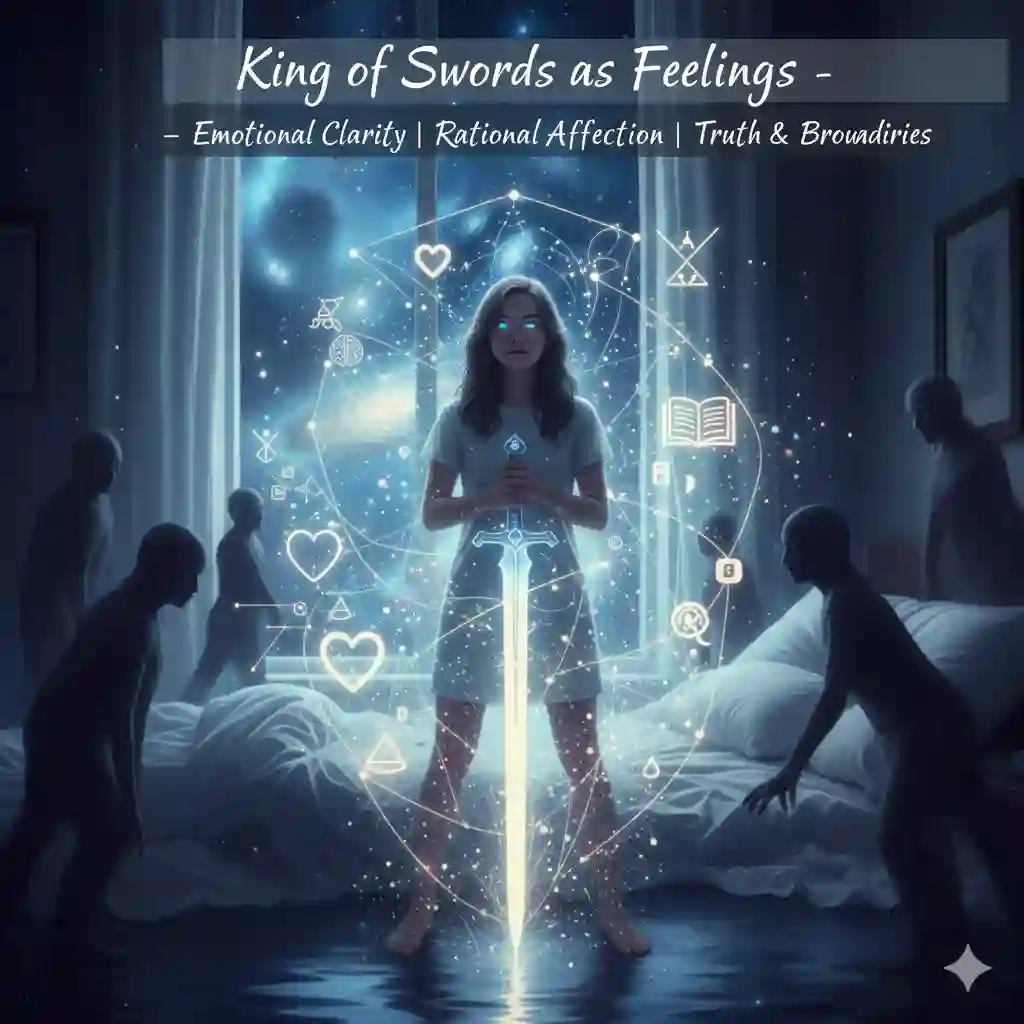
When this card appears in a reading about emotions, it signals:
- Swords as thought, truth, and communication: The air element drives feelings through the filter of the mind, seeking understanding and logical coherence.
- King as mastery and emotional authority: A state of being in command of one’s internal landscape, rather than being ruled by it.
- Feelings expressed through clarity, not intensity: Affection is shown through honesty, reliability, and clear communication rather than dramatic displays.
- Boundaries as emotional respect: The understanding that healthy structures create safe spaces for feelings to exist without chaos.
This King does not repress emotion; he refines it. He represents the point where the heart and head align, allowing for a love that is intelligent, ethical, and profoundly honest.
Introduction: Why the King of Swords Appears as Feelings
In a culture that often equates love with unbridled passion or chaotic intensity, the King of Swords offers a different paradigm: the romance of clarity. When this card appears as feelings, it suggests a maturation of emotional energy. It moves away from the reactive nature of the Page or the impulsive drive of the Knight, settling into a state of masterful oversight. It represents emotions that have been processed, analyzed, and accepted.
The appearance of the King of Swords invites us to understand that some emotions mature into clarity rather than deepening into complexity. It challenges the notion that “thinking” and “feeling” are enemies. Instead, it proposes that the highest form of feeling often requires the highest form of thinking. Emotional regulation is distinct from emotional suppression; the former is a skill of the King, while the latter is a fear-based reaction. This King regulates his emotions not to hide them, but to ensure they are expressed with precision and integrity.
Furthermore, this card highlights the role of honesty in emotional connection. To the King of Swords, truth is the ultimate love language. If he cares for you, he will offer you the truth—even if it is difficult—because he respects you enough to be real. Love, in this context, is expressed through guidance, protection, and an unwavering commitment to reality. It is a stabilizing force, offering a safe harbor of logic in a stormy emotional sea.
Emotional Core Meaning of the King of Swords
At its core, the King of Swords represents rational affection. This is not an oxymoron. It is the kind of deep care that considers the well-being of the other person from a logical, long-term perspective. It is the love of a mentor, a protector, or a partner who values your growth as much as your comfort.
Rational Affection and Thoughtful Attachment
The feelings associated with this card are thoughtful. Before the King of Swords acts on an emotion, he examines it. “Is this feeling true? Is it helpful? Is it fair?” This process creates a thoughtful attachment. He doesn’t just fall in love; he decides to love based on compatibility, shared values, and mutual respect. This makes the bond incredibly strong because it isn’t dependent on fleeting moods.
Emotional Responsibility and Fairness
This King embodies the archetype of the judge. In feelings, this translates to a high degree of emotional responsibility and fairness. He strives to treat his partner and himself with justice. He will not manipulate emotions to get his way, nor will he tolerate being manipulated. His feelings are anchored in an ethical framework where keeping one’s word is a sacred duty.
Valuing Truth Over Emotional Dramatics
Drama repels the King of Swords. He views emotional theatrics as a distraction from the truth. His core emotional drive is to cut through the noise to find the signal. He values partners who can articulate their needs clearly and who appreciate direct communication. To him, clarity is kindness.
Respect as a Form of Love
For the King of Swords, respect is the highest form of love. If he respects you—your mind, your boundaries, your independence—he loves you. His feelings are inextricably linked to his esteem for your character. He feels most connected when he is engaged in an intellectual exchange or when he sees you acting with integrity.
Psychological Interpretation of the King of Swords as Feelings
Psychologically, the King of Swords represents the triumph of the prefrontal cortex—the center of logic and decision-making—over the amygdala, the seat of emotional reactivity. It symbolizes a highly developed ego strength capable of managing complex emotional states without becoming overwhelmed.
Emotional Self-Regulation and Boundaries
The primary psychological trait here is self-regulation. The King of Swords feels anger, sadness, and joy, but he chooses how and when to express them. He sets firm boundaries not to keep people out, but to protect his own mental clarity. Psychologically, this suggests a person who is secure in their identity and does not need to merge with another to feel whole.
Intellectual Processing of Emotions
This card indicates a person who processes emotions intellectually. When they feel something, their first instinct is to analyze it. “Why am I feeling this? What triggered it?” This intellectualization is a tool for understanding, not avoidance. It allows them to gain perspective on their feelings, turning raw data into wisdom.
Fear of Emotional Chaos—Not Intimacy
It is a common misconception that this King fears intimacy. Psychologically, what he actually fears is emotional chaos. He fears the loss of rationality that often accompanies intense emotional states. He seeks an intimacy that is safe, structured, and intelligible. He wants to be close, but he wants to remain sane while doing so.
Communication as Emotional Safety
For the King of Swords, talk is not cheap; it is the currency of safety. Clear communication alleviates anxiety. Knowing exactly where he stands and what is expected creates a psychological environment where he can relax and open up. Ambiguity is threatening to his psychological sense of order; clarity is his safe space.
Spiritual Meaning of the King of Swords as Feelings
Spiritually, the King of Swords represents the path of Jnana Yoga—the yoga of knowledge and wisdom. It is the spiritual practice of discernment, using the sword of truth to cut away illusion and reveal the divine nature of reality.
Emotional Wisdom Through Discernment
In the realm of feelings, this spiritual energy manifests as discernment. It is the ability to distinguish between ego-based desires and soul-based truths. The King of Swords encourages us to look at our relationships with the eyes of wisdom, seeing past the projections and fantasies to the true essence of the connection.
Integrity as Spiritual Maturity
This card aligns emotional integrity with spiritual maturity. It teaches that to be spiritual is to be truthful. Hiding our true feelings to “keep the peace” is a violation of spiritual law for the King of Swords. His feelings compel him to live in alignment with his highest ethical standards, making his relationships a practice ground for his spiritual values.
Truth as Emotional Alignment
The King of Swords understands that the truth has a vibration. When we speak and live our truth, we come into alignment with the universe. Emotionally, this feels like a deep resonance—a sense that everything is in its right place. He seeks this vibrational truth in his connections, preferring a hard truth that aligns him with reality over a comforting lie that creates dissonance.
Conscious Emotional Leadership
Spiritually, this King is a leader. He takes responsibility for the emotional tone of his environment. He holds the space for truth and clarity, guiding others away from confusion and toward understanding. His feelings are a form of service, offering the gift of clarity to those he cares for.
Upright King of Swords as Feelings
When the King of Swords appears upright in a reading about feelings, it is a positive sign of clarity, respect, and honorable intentions. The feelings are present, but they are composed.
- Clear-Headed Affection: The person knows exactly how they feel about you. There is no confusion or ambiguity. They have thought about it, processed it, and arrived at a conclusion. They care for you, and that care is a conscious choice.
- Honest Emotional Communication: They are willing to communicate their feelings honestly. They won’t play games or leave you guessing. If they say they care, they mean it. Their words are a direct reflection of their internal state.
- Feelings Guided by Ethics and Logic: Their affection is guided by their moral compass. They will treat you right because it is the right thing to do. Their logic supports their love, ensuring that the relationship is practical and sustainable.
- Emotional Protection Through Boundaries: They express their care by establishing and respecting boundaries. They want to ensure that the relationship is healthy and that neither of you loses your individuality. They protect the relationship by keeping it defined and clear.
Reversed King of Swords as Feelings
When the King of Swords is reversed, the healthy integration of head and heart is disrupted. The logic becomes a weapon, or the clarity becomes coldness.
- Emotional Detachment Through Overthinking: The person may be thinking themselves out of their feelings. They are over-analyzing the relationship to the point of paralysis, finding logical reasons to detach rather than engaging with the vulnerability of the connection.
- Suppressed Feelings Masked as Logic: They might be using “logic” as a mask for fear. They claim to be making a rational decision to step back, but in reality, they are suppressing emotions they are afraid to feel. The sword is used to cut off the heart, not to clarify it.
- Fear of Vulnerability Disguised as Control: The reversed King can become controlling or critical as a way to manage his fear of vulnerability. By critiquing the relationship or the partner, he keeps the focus on the mental plane and avoids the messy reality of emotional intimacy.
- Misuse of Logic to Avoid Emotional Exposure: This reflects a person who argues their way out of feelings. They might demand logical proof for emotions or dismiss feelings as “irrational.” It creates a dynamic where emotional connection is stifled by a demand for intellectual perfection.
King of Swords as Feelings in Romantic Connections
In romance, the King of Swords represents a mature, intellectual, and highly respectful love. It is the partner who challenges you to be your best self.
Respectful, Thoughtful Attraction
The attraction here starts in the mind. They are attracted to your intelligence, your wit, and your integrity. They admire you. This respect forms the foundation of their romantic feelings. They view you as an equal and a partner, not just a lover.
Desire for Intelligent Emotional Exchange
They crave conversation. For the King of Swords, a stimulating debate is foreplay. They feel most loved when they are understood intellectually. They want a partner with whom they can share ideas, solve problems, and navigate the complexities of life.
Emotional Loyalty Through Consistency and Truth
This is not a fair-weather lover. Once they have made a logical commitment to you, they are incredibly loyal. Their feelings are stable because they are based on facts and character, which don’t change overnight. You can trust them to be consistent.
Love Shown Through Advice, Guidance, and Protection
Their love language is often advice. If they are constantly trying to help you solve problems or offering logical perspectives on your struggles, it is a sign of deep affection. They want to protect you from error and pain using the tool they know best: their mind.
King of Swords During Emotional Distance or Conflict
When conflict arises or distance grows, the King of Swords retreats into his mind to find his footing.
- Emotional Withdrawal to Regain Clarity: If they pull away, it is usually to think. They need to process the conflict without the noise of emotional reactivity. They withdraw to regain their objectivity so they can return to the conversation with a clear head.
- Processing Feelings Before Speaking: They will not lash out in the heat of the moment. They will wait until they have formulated their thoughts. This silence can be misinterpreted as coldness, but it is actually a form of emotional discipline to prevent saying something regretful.
- Choosing Truth Over Emotional Reactivity: In a conflict, they will prioritize the truth. They want to get to the bottom of what actually happened rather than focusing solely on how it felt. They believe that solving the factual problem will resolve the emotional one.
- Calm Detachment as Self-Regulation: Their detachment is a safety mechanism. By stepping back and viewing the situation like a third-party observer, they keep their own emotions from hijacking the resolution process.
King of Swords Compared to Other Feelings Cards
Understanding the King of Swords requires distinguishing his mental mastery from other forms of authority and emotion.
- King of Swords vs. King of Cups: The King of Cups emotional mastery masters emotion by diving into it and navigating the waters with compassion. The King of Swords masters emotion by rising above it and observing it from the air. One is immersion; the other is perspective.
- King of Swords vs. Queen of Swords: The Queen of Swords emotional perception uses her intellect to protect her heart and cut through lies with sharp perception. The King acts with more structural authority; he builds systems of truth. The Queen is the critic; the King is the judge.
- King of Swords vs. Knight of Swords: The Knight of Swords emotional impulse is hasty, rushing into battle with the truth as a weapon. The King is the Knight matured. He wields the same sword but with patience, strategy, and wisdom, seeking resolution rather than just victory.
- King of Swords vs. The Emperor: The Emperor emotional authority controls through structure, rules, and fiery will. The King of Swords controls through logic, ethics, and clear communication. The Emperor builds the empire; the King of Swords writes the laws that govern it.
Emotional Challenges Hidden in the King of Swords
Even with his clarity, the King of Swords faces distinct emotional hurdles.
- Over-Intellectualizing Feelings: The danger is reducing human experience to data points. He may struggle to simply “be” with a feeling without needing to dissect it, missing the healing power of raw, unanalyzed emotion.
- Emotional Distance Mistaken for Strength: He may confuse stoicism with strength, believing that showing emotion is a weakness. This can lead to isolation, where he is respected but not truly known or held.
- Fear of Emotional Unpredictability: He struggles with the messy, nonlinear nature of love. He wants feelings to make sense, and when they don’t, he can become anxious or dismissive.
- Choosing Being Right Over Being Happy: In his quest for truth, he can sometimes win the argument but lose the connection. The challenge is learning that in relationships, subjective emotional truth is just as valid as objective factual truth.
Reflective Questions for Interpreting the King of Swords as Feelings
When the King of Swords appears, it invites a cerebral audit of the emotional landscape.
- Are feelings being honored—or managed? Is the logic serving to express the emotion safely, or is it being used to contain and stifle it?
- Where is clarity serving connection? How has honesty brought you closer? Where has a lack of ambiguity created safety?
- Where might logic be replacing vulnerability? Are you explaining your feelings instead of feeling them? Are you offering a thesis statement instead of your heart?
- How can truth coexist with tenderness? Can you be honest without being harsh? Can you be logical without being cold?
Deep Emotional Message of the King of Swords
The deepest message of this card is that a clear mind is the guardian of a true heart.
When the King of Swords appears as feelings, it signals emotional maturity that values truth, respect, and clear communication. It reminds us that love does not have to be chaotic to be real. It can be calm, it can be sensible, and it can be wise. Love may be calm and restrained—but it is intentional, ethical, and deeply aware. It suggests that the highest expression of affection is to see someone clearly, to speak to them honestly, and to honor the covenant of the relationship with unwavering integrity. This is the energy of the Two of Cups emotional balance elevated by wisdom and the discernment of Justice emotional truth.
Frequently Asked Questions (FAQs)
What does the King of Swords mean as feelings?
It means the person feels a clear, rational, and respectful affection. They are processing their emotions through their intellect, valuing honesty and mental connection. They are serious about their feelings and express them with integrity.
Is this card emotionally cold or just reserved?
It is usually reserved, not cold. The King of Swords feels deeply, but he values self-control. He doesn’t believe in splashing emotions everywhere. His warmth is found in his reliability and his engagement, not in dramatic displays.
Can logical people feel deeply in love?
Absolutely. The King of Swords proves that logic and love are not mutually exclusive. His love is deep because it is chosen. He loves with his whole mind, which grounds his heart in reality.
What does emotional detachment really mean here?
It means the ability to step back and look at feelings objectively. It is a tool for clarity, not abandonment. It allows him to solve relationship problems without being blinded by reactivity.
How does this card express love differently?
He expresses love through conversation, advice, protection, and honesty. He shows he cares by engaging with your mind and respecting your boundaries. He is the partner who helps you rewrite your resume or talks you through a crisis at 3 AM.
Does the King of Swords indicate a breakup?
Not inherently. However, if the relationship is illogical, toxic, or dishonest, the King of Swords creates the clarity needed to end it. He will cut away what is not working to preserve his peace.
What if I want more romance than he gives?
This can be a challenge. You may need to communicate your need for romance logically. Explain why romance is important to the relationship’s health. He responds well to clear reasoning.
Is he playing mind games?
Upright, no. He hates games. He values directness. Reversed, he might use his intellect to manipulate, but upright, he is one of the most straightforward cards in the deck.
How do I connect with the King of Swords emotionally?
Talk to him. Be honest. Be direct. Don’t use passive-aggressive tactics. Engage his intellect. Show him that you are a partner who values truth as much as he does.
Can this card represent a woman?
Yes. Tarot court cards represent energy, not gender. A woman embodying the King of Swords is decisive, articulate, clear-headed, and values intellectual connection in her relationships.
What is the “truth” he values in love?
It is the reality of who you are and who he is, without the filter of rose-colored glasses. He values the The Lovers emotional choice to be authentic.
Does he hide his feelings?
He doesn’t hide them so much as he filters them. He will only share what he thinks is relevant or ready to be shared. He is private, but not necessarily secretive.
Is the King of Swords faithful?
Generally, yes. He values his own code of ethics. If he has committed to monogamy, he will stick to it because breaking his word would violate his own sense of integrity.
Why does he act so serious?
He takes life and relationships seriously. He feels the weight of responsibility. However, once he feels safe and the structure is secure, he often has a very dry, witty sense of humor.
For more guidance on navigating the complex landscape of tarot emotions, visit our Tarot feelings interpretation hub.