Fast Answer: Six of Pentacles as Feelings
When the Six of Pentacles as feelings appears in a tarot reading, it signifies a state of emotional reciprocity, generosity, balance, fairness, and a keen awareness of the dynamics of give-and-take. It reflects the heart’s capacity to engage in relationships that are equitable, supportive, and mutually nourishing.
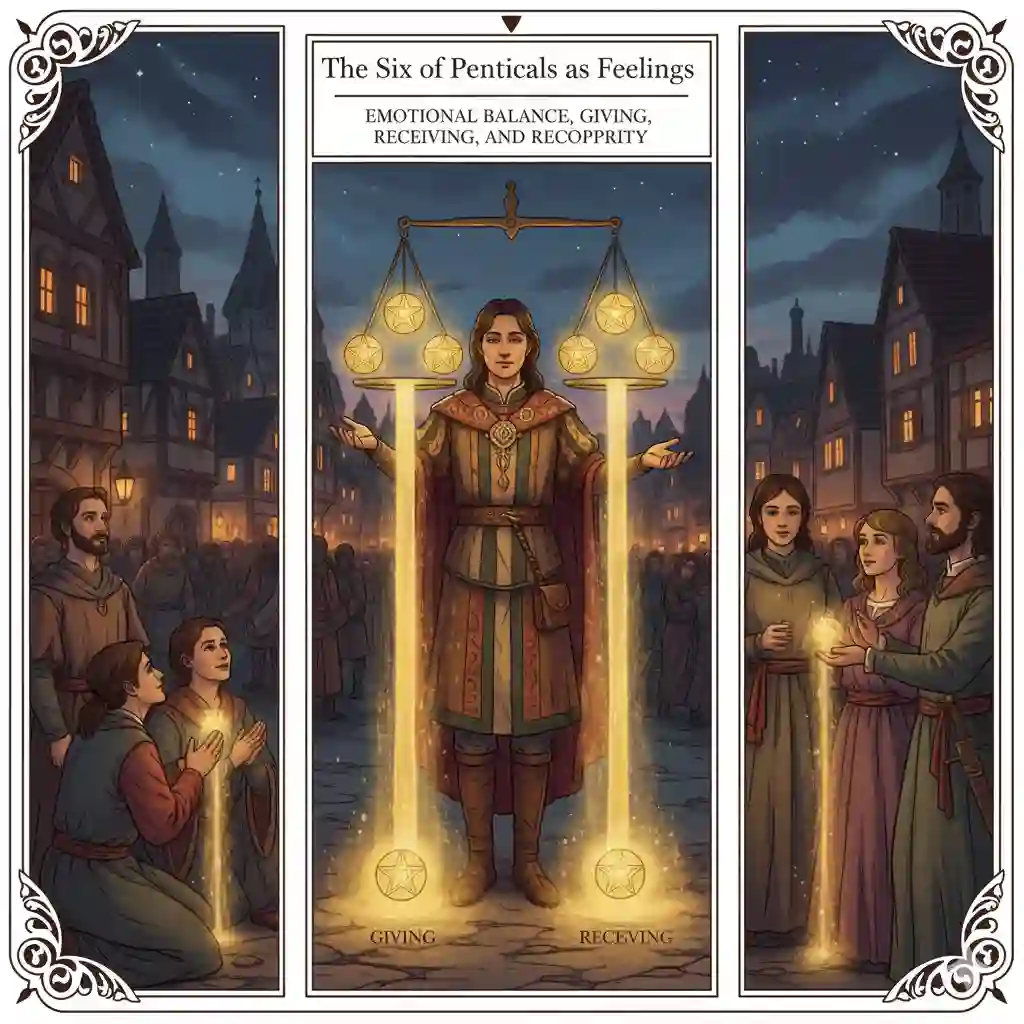
To clarify immediately:
- Not literal charity or material exchange: While the imagery often depicts financial charity, in a feelings context, this translates to the currency of emotion—time, attention, care, and validation.
- Reflects how we experience and express emotional balance: It highlights the equilibrium between what we offer to others and what we allow ourselves to receive.
- Emotional giving and receiving must be healthy, not manipulative: The card asks us to examine the intentions behind our generosity and our openness to support, ensuring they stem from genuine care rather than a desire for control or validation.
Emotional Complexity Behind the Six of Pentacles
The Six of Pentacles is a deceptively simple card that hides profound emotional complexity. On the surface, it looks like a straightforward transaction of aid. However, deeply interpreting the Six of Pentacles feelings meaning requires us to navigate the subtle psychological waters of power dynamics, self-worth, and dependency.
We must explore the tension between balance and emotional codependency. True balance is dynamic and shifting; sometimes we give more, sometimes we receive more. Codependency, however, locks us into rigid roles of “the giver” or “the taker.” The Six of Pentacles asks us to identify which script we are following. Are we giving to empower, or are we giving to create dependency?
Furthermore, there is a complex interplay between generosity and resentment. Generosity that is not met with reciprocity often sours into resentment. This card challenges us to feel the weight of our own emotional expenditures. It asks us to confront the difference between fairness vs. guilt or obligation. Do we give because we want to, or because we feel we owe it? Do we receive with gratitude, or do we feel burdened by the need to repay? The ultimate goal of this emotional archetype is awareness of reciprocity without the heavy ledger of emotional debt.
Positive Emotional Archetype
In its highest expression, the Six of Pentacles represents a beautiful state of emotional health and social harmony. It is the archetype of the benevolent heart that understands that we are all interconnected.
Emotional Generosity and Empathy
The positive Six of Pentacles feels expansive. It represents a person who has enough emotional resources to share. They are not scraping the bottom of the barrel; their cup is full enough to pour into yours. This generosity is fueled by empathy—the ability to recognize another’s need and the willingness to meet it without judgment.
Joy in Both Giving and Receiving Support
A key aspect of this positive archetype is the fluidity between roles. The healthy Six of Pentacles feels just as much joy in receiving support as they do in offering it. There is no shame in needing help, and no arrogance in providing it. The feelings are characterized by a lack of ego; it is simply energy moving where it is needed most.
Emotional Fairness and Integrity
This card embodies a deep sense of fairness. The person feeling this energy values equity in their connections. They are acutely aware if they are taking up too much space or not enough. This integrity ensures that relationships remain sustainable. They strive for emotional balance tarot teaches is the foundation of longevity.
Healthy Interdependence Without Loss of Self
Finally, the positive Six of Pentacles represents healthy interdependence. It acknowledges that we need each other, but it does not require us to lose ourselves to be in relationship. We can support each other’s growth without becoming responsible for each other’s happiness.
Challenging Emotional State
When the energy of the Six of Pentacles is distorted, the scales tip, and the feelings become heavy with imbalance and unspoken contracts.
Imbalanced Giving or Over-Reliance on Others
The shadow side often manifests as the martyr or the dependent. One person may feel they are doing all the emotional heavy lifting, constantly pouring energy into a black hole. Conversely, someone may feel entirely reliant on another for their emotional stability, creating a power dynamic that breeds insecurity and fear of abandonment.
Emotional Guilt or Manipulation
Sometimes, generosity is used as a weapon. “I did this for you, so now you must do this for me.” The feelings here are transactional and manipulative. Gifts (whether material or emotional) come with strings attached. This creates an atmosphere of guilt, where love feels like a debt that can never be fully repaid.
Feeling Undervalued or Unappreciated
If the flow of energy is one-way, feelings of being undervalued quickly arise. The giver feels unseen, used, only valuable for what they provide rather than who they are. The receiver may feel patronized or incapable, their autonomy slowly eroded by “help” they didn’t ask for or couldn’t reciprocate.
Difficulty Maintaining Healthy Boundaries
The core challenge often lies in boundaries. The Six of Pentacles requires us to know where we end and another begins. Without this, we over-give to the point of exhaustion or over-take to the point of entitlement. Awareness and reflection can restore emotional balance, but it requires the courage to say “no” or “I need help.”
Emotional Tone & Energy
The tone of the Six of Pentacles depends entirely on the health of the dynamic.
- Calm, generous, and aware vs. anxious, resentful, or transactional: Healthy energy feels light, open, and free. There is no scorekeeping. Unhealthy energy feels tight, anxious, and calculated. Every interaction is weighed and measured.
- Reciprocity as empowerment vs. obligation as burden: In a balanced state, reciprocity feels empowering—it affirms our capability and connection. In an imbalanced state, obligation feels like a heavy chain, dragging down the spirit. The energy shifts from “I get to help” to “I have to help.”
Psychological Interpretation
Psychologically, the Six of Pentacles is a masterclass in social exchange theory and emotional intelligence. It governs how we navigate the complex web of human needs.
Emotional Intelligence and Social Reciprocity
This card represents high emotional intelligence regarding social dynamics. It is the ability to read the room, to sense who is in need, and to respond appropriately. It involves understanding the unspoken rules of reciprocity that govern human bonding. When we feel the Six of Pentacles, we are attuned to the “emotional economy” of our relationships.
Setting Boundaries While Remaining Generous
One of the most difficult psychological tasks is to be generous without being self-sacrificing. The Six of Pentacles asks us to engage in emotional boundaries in tarot relationships require. It suggests a psychological state where self-preservation and altruism coexist. We give from our surplus, not our sustenance.
Emotional Validation of Self and Others
The act of giving—whether it’s listening, validating, or supporting—is a powerful psychological tool. It signals, “You matter. Your needs are valid.” The Six of Pentacles represents the feeling of validating others and, crucially, allowing oneself to be validated. It heals the wound of invisibility.
Recognizing Unhealthy Patterns in Give-and-Take
Psychologically, this card often appears to highlight patterns learned in childhood. Did we have to “earn” love by being helpful? Were we taught that having needs was selfish? The Six of Pentacles invites us to examine these scripts and rewrite them into a healthier narrative of tarot give and take.
Spiritual Interpretation
Spiritually, the Six of Pentacles elevates the concept of exchange from a transaction to a sacrament. It aligns with the universal law of circulation: what goes around comes around.
Emotional Generosity as a Spiritual Practice
Giving becomes a spiritual practice when it is done without attachment to outcome. The feelings associated with this card are those of being a conduit for divine love. We are not the source of the water; we are the pipe through which it flows. This detachment allows for pure emotional generosity tarot embodies.
Lessons in Gratitude, Balance, and Mutual Support
Spiritually, receiving is just as holy as giving. It is an act of humility and trust. The Six of Pentacles teaches us gratitude for the support we receive from the universe and the people around us. It reminds us that we are not meant to do this alone. Mutual support is the web of life in action.
Integrating Generosity Without Loss of Self or Autonomy
The spiritual challenge is to merge with others in service while maintaining our own sovereign soul journey. We learn that we can be generous without dissolving our own path. We support others on their journey, but we cannot walk it for them. This distinction is vital for spiritual hygiene.
Romantic Feelings
In the context of romance, the Six of Pentacles speaks to the health of the partnership’s ecosystem.
Healthy Giving and Receiving in Love
When this card appears as feelings in love, it indicates a relationship where needs are being met. Both partners feel supported. One cooks dinner while the other listens to a work vent. One offers financial stability while the other offers emotional grounding. The feelings are of gratitude, safety, and equity.
Avoiding Emotional Imbalance or Dependency
However, it can also act as a warning. Are you acting as a parent to your partner? Are you buying their affection with gifts or acts of service because you fear they won’t love you otherwise? The Six of Pentacles asks for an honest audit of the romantic ledger. It warns against the dynamic where one person is the “savior” and the other the “project.”
Emotional Fairness as Foundation for Trust
Trust is built on fairness. If one partner constantly takes without giving back, resentment erodes trust. The feelings of the Six of Pentacles in romance are centered on the belief that “my partner has my back as much as I have theirs.” This perceived fairness allows the heart to relax and open fully.
During Conflict or Separation
Even when things are difficult, the principles of the Six of Pentacles remain relevant.
Maintaining Balance and Fairness Under Stress
Conflict often makes us selfish; we retreat into our own pain. The Six of Pentacles asks us to maintain a balanced perspective even when hurting. Can we still hear our partner’s side? Can we validate their feelings even while disagreeing? This emotional fairness prevents conflict from becoming destructive.
Avoiding Emotional Overextension or Withdrawal
During separation or stress, there is a tendency to either over-pursue (give too much to fix it) or completely withdraw (give nothing to protect oneself). The Six of Pentacles suggests finding a middle ground. It advises against Seven of Cups vs Six of Pentacles feelings confusion, urging us to stay grounded in practical, measured exchanges.
Recognizing Mutual Responsibility in Emotional Dynamics
It takes two to tango. The Six of Pentacles reminds us that relationship dynamics are co-created. Both parties contribute to the balance or imbalance. Recognizing this mutual responsibility is the first step toward resolution.
Hidden Emotional Challenges
Underneath the seemingly positive exterior of this card, several hidden challenges can lurk.
- Subconscious Patterns of Over-Giving: Often, people who identify strongly with this card are chronic over-givers who use generosity to control their environment or avoid intimacy. They give so they don’t have to receive (which feels vulnerable).
- Emotional Guilt or Obligation: The feeling of being “in debt” emotionally can be paralyzing. It can keep people in relationships long past their expiration date simply because they feel they “owe” the other person.
- Difficulty Asking for Support: The figure standing and giving often has a harder time kneeling and receiving. The challenge is to admit vulnerability and allow others the gift of giving to you.
Reflective Questions
To deepen your understanding of the Six of Pentacles as feelings, ask yourself:
- Am I giving freely, or is there a hidden price tag of expectation attached?
- Do I allow myself to receive emotional support, or do I deflect it?
- Are my emotional exchanges balanced, or do I feel drained/resentful?
- How can I maintain fairness in this connection without keeping a scorecard?
- Am I trying to buy love with my helpfulness?
Integrative Emotional Message
The Six of Pentacles teaches us that love is an active verb, a constant flow of energy between souls.
The Six of Pentacles teaches us the emotional art of give-and-take.
Healthy generosity and reciprocity nurture both self and others.
Emotional balance is not just fairness—it is freedom, integrity, and mutual care.
When we master the lessons of this card, we move beyond transactional relationships into transformational ones, where the act of giving and receiving becomes a seamless dance of mutual empowerment. This leads to the stability found in the King of Pentacles emotional guidance.
For more insights into interpreting tarot emotions, visit our Tarot feelings hub.
Frequently Asked Questions (FAQs)
Is the Six of Pentacles always about giving?
No, it is equally about receiving. It represents the flow between the two. Depending on your position in the situation, it may be highlighting your need to accept help graciously rather than offering it.
How does it reveal hidden emotional imbalances?
If you feel drained, resentful, or superior when this card appears, it indicates you are over-giving. If you feel small, indebted, or dependent, it indicates you are over-receiving. The card acts as a mirror for these power dynamics.
Can emotional generosity become harmful?
Yes, when it enables destructive behavior or comes at the expense of your own well-being. This is often called “enabling” rather than helping. True generosity supports growth; harmful generosity supports stagnation.
How to maintain reciprocity without resentment?
By setting clear boundaries and communicating needs. Resentment grows in the silence of unmet expectations. Being vocal about what you need to receive creates the opportunity for true reciprocity.
How does it show in romantic feelings?
It shows as a desire to support the partner and be supported in return. It indicates a practical love that shows up in tangible ways—doing chores, listening, sharing resources. It is love in action.
Is this a good card for reconciliation?
It is generally positive, suggesting a willingness to make amends and balance the scales. However, it implies that effort is required from both sides to restore equity.
What if I am the one always begging for crumbs?
The Six of Pentacles in this context validates your feelings of scarcity. It suggests that the current dynamic is not meeting your needs and asks you to examine why you accept relationships where you must beg for basics.
Does this card imply a power dynamic?
Yes, the visual of the merchant and the beggars implies a hierarchy. In feelings, this can manifest as one person holding more emotional power or stability than the other. The goal is to use that power to uplift, not oppress.
How does it relate to the Five of Pentacles?
The Five represents the feeling of lack and isolation. The Six represents the solution—the introduction of help and resources. It is the movement from “I have nothing” to “I am supported.”
Can it mean financial stress impacting feelings?
Absolutely. Since Pentacles rule the material, this card often appears when financial worries are bleeding into emotional connections, creating stress or dependency.
Is the Six of Pentacles feeling manipulative?
It can be. If the giving is done to create obligation (“I did this, so you owe me”), it is manipulative. Upright, it usually seeks genuine balance, but reversed or ill-dignified, it can be transactional.
How does it compare to the Two of Pentacles?
The Two deals with juggling priorities internally. The Six deals with the exchange of energy between people. The Two is a solo act; the Six is a social interaction.
What does it mean for self-love?
It asks if you are giving to yourself as much as you give to others. It is a call to treat yourself with the same generosity you offer the world.
Can it indicate a mentor/mentee feeling?
Yes. The dynamic of one person having more experience or stability sharing it with another is very characteristic of the Six of Pentacles.
Is this card about justice?
It is about fairness, which is a softer form of justice. Justice (Major Arcana) is about universal law and truth; Six of Pentacles is about interpersonal equity and kindness.
Does it mean I need to pay someone back?
Emotionally, perhaps. It might suggest acknowledging someone’s kindness or returning a favor to restore the energetic balance in the relationship.
Why do I feel guilty with this card?
You may have a block around receiving. If you feel you don’t deserve help, this card will trigger guilt. It challenges you to accept your worthiness of support.
What is the shadow of the Six of Pentacles?
The shadow is the strings attached to the gift. It is charity that humiliates the receiver or generosity that bankrupts the giver.
How does it relate to emotional intelligence?
It represents the practical application of EQ—knowing when to speak, when to listen, when to step in, and when to step back. It is emotional intelligence in tarot in practice.
What is the key takeaway?
That relationships are an ecosystem. You cannot take without depleting the source, and you cannot give without refilling your own cup. Balance is the key to survival.