Fast Answer: Six of Cups in Love Meaning
The Six of Cups in love reflects familiarity, past attachment, emotional memory, and soul-deep comfort. It is rarely about new, fiery passion; instead, it speaks to the bonds that feel safe, innocent, and enduring.
Upright, this card signals reconnection, sweet affection, and genuine emotional warmth. It can indicate a returning lover, but more often, it highlights a relationship built on a profound sense of shared history or “soul recognition.” It represents safety, vulnerability, and the kind of love that feels like coming home.
Reversed, the Six of Cups warns of emotional looping, unresolved past love, and romanticizing what once was at the expense of what is. It suggests you may be looking backward rather than forward, stuck in a cycle of “the one that got away” or repeating childhood attachment wounds in your adult relationships.
Ultimately, this card asks a critical question: Is your love rooted in growth and genuine connection, or are you clinging to a memory because it feels safer than the unknown?
Introduction: Why the Six of Cups Is One of the Most Misunderstood Love Cards
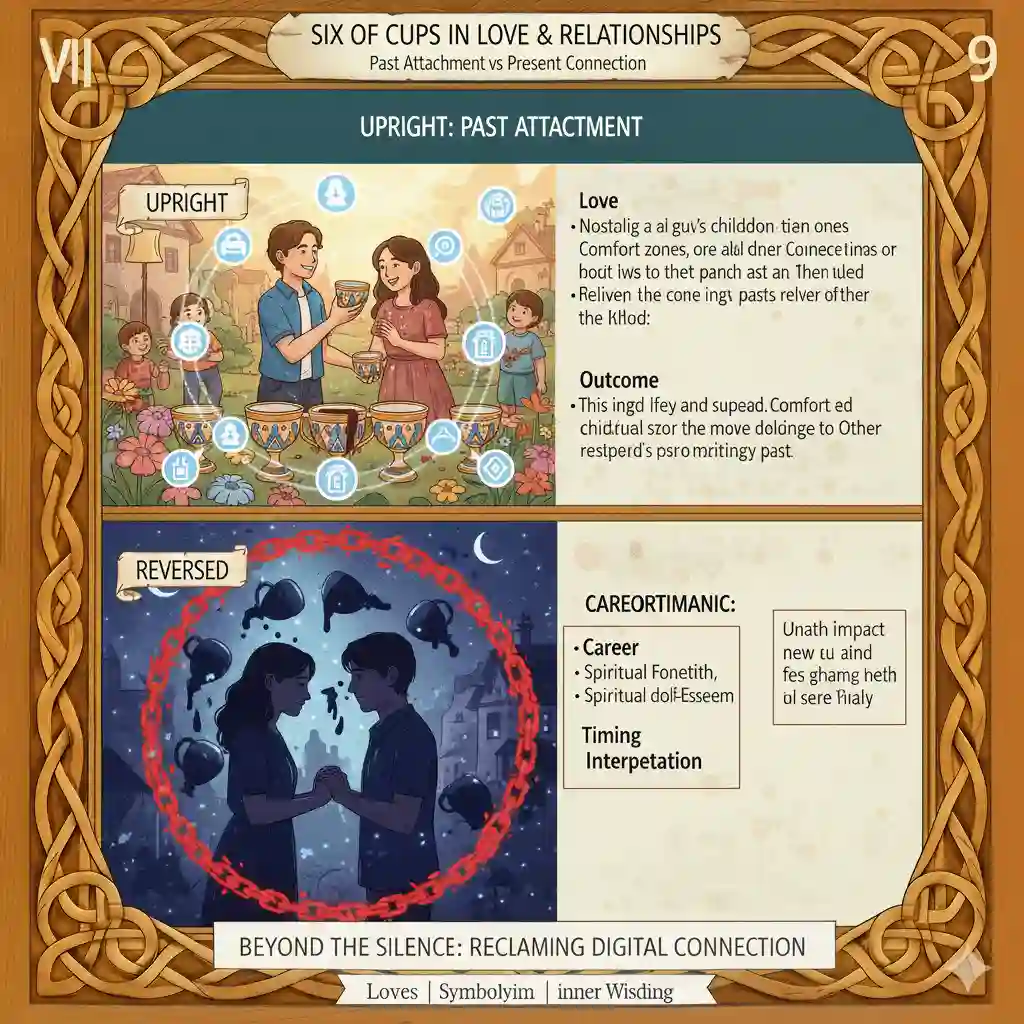
In the realm of romance, few cards trigger as much immediate hope—and eventual confusion—as the Six of Cups. For many, seeing this card in a spread is interpreted solely as “the ex is coming back.” While reconciliation is certainly within its scope, limiting the Six of Cups to this single definition misses its profound psychological depth.
The Six of Cups is the card of emotional imprinting. It governs our earliest memories of love, safety, and belonging. When it appears in a love reading, it isn’t just talking about a specific person from your history; it is revealing the template of love you are currently operating from. It asks us to examine our attachment patterns, often formed long before we ever had our first romantic relationship.
We often mistake familiarity for compatibility. We gravitate toward partners who make us feel “safe,” but sometimes, that safety is merely the comfort of a familiar pain or a known dynamic. The Six of Cups challenges us to distinguish between a soulmate connection that fosters growth and a trauma bond that keeps us small. It invites us to look at love through the lens of our inner child: are we seeking a partner, or are we seeking a parent, a savior, or a return to a simpler time?
Core Symbolism of the Six of Cups in Romance
To understand the Six of Cups in love meaning, we must look at its imagery. In the classic Rider-Waite-Smith deck, we see two children in a village courtyard. One offers a cup filled with flowers to the other. The scene is bathed in golden light, suggesting nostalgia, innocence, and a protected environment.
- Children: Represent the inner child within our relationships. They symbolize a love that is unburdened by cynicism, transactional expectations, or adult games. It is pure, vulnerable, and trusting.
- The Courtyard: Symbolizes safety and boundaries. Love, under this influence, feels like a sanctuary from the harshness of the outside world.
- The Flowers: Represent memories and gifts from the past. They are beautiful, but cut flowers do not last forever unless they are planted in new soil. This is the core tension of the card: enjoying the beauty of the memory while ensuring there is still life in the roots.
In love, this symbolism translates to a connection that feels “fated” or incredibly comfortable. It suggests a relationship where you can let your guard down and be your most authentic, unmasked self.
Upright Six of Cups in Love (Deep Dive)
When the Six of Cups appears upright in a love reading, it is a gentle and auspicious sign. It suggests that the past is influencing the present in a benevolent, supportive way. This isn’t about baggage; it’s about foundation.
Reconnecting with Someone Meaningful
The most literal interpretation—and a common one—is the return of someone significant. This could be a childhood sweetheart, a former partner with whom you have unfinished positive business, or a friend who becomes something more. Unlike other “return” cards that might bring chaos, the upright Six of Cups suggests this reunion is healing. The timing is finally right.
Emotional Sincerity and Vulnerability
This card signals a relationship free from power dynamics. There is no “chase,” no playing hard to get. The energy is sweet, kind, and incredibly tender. Partners feel safe sharing their dreams, fears, and silly quirks. It fosters an environment where vulnerability is met with care, not judgment.
“We’ve Known Each Other Before” Energy
Even in new relationships, the upright Six of Cups brings a sense of déjà vu. You might feel like you’ve known this person for lifetimes. The conversation flows effortlessly, and there is an instinctive understanding of each other’s emotional landscapes.
A) If You Are Single
If you are single, the Six of Cups suggests that love may come from your existing circle or your past. You might run into someone from high school, or a friend might suddenly appear in a romantic light.
More deeply, it indicates you are vibrating at a frequency of emotional safety. You are done with the “bad boys” or the chaotic flings. You are ready for something that nurtures your heart. This card often appears when you have done significant healing work and are ready to receive love that honors your inner child. It aligns beautifully with the energy of the Ace of Cups, which represents emotional readiness and new opportunities. You aren’t just looking for a date; you are looking for a sanctuary.
B) If You Are in a Relationship
For those already coupled, the upright Six of Cups is a beautiful omen. It suggests a deepening of emotional intimacy. You and your partner may be revisiting shared memories—looking at old photos, visiting the place you met, or simply laughing about inside jokes. These shared roots strengthen the tree of your relationship.
It can also indicate a phase where the relationship feels more innocent and playful. You might find yourselves prioritizing simple joys—cooking together, walks in the park, or being silly—over grand, performative gestures. This echoes the communal joy and bond celebration found in the Three of Cups. It’s a reminder that the strongest bonds are often built in quiet moments of shared happiness.
C) As Feelings
If you are asking how someone feels about you, the Six of Cups is one of the sweetest cards to receive. It means they view you with immense tenderness. They feel protective of you and deeply affectionate.
Their feelings are not necessarily burning with lust (though attraction is there); rather, they are glowing with warmth. They miss you when you aren’t around—not in a desperate way, but in a way that feels like a piece of them is absent. They likely reminisce about your interactions and hold a sentimental longing for your presence. You feel “familiar” to their soul.
Reversed Six of Cups in Love (Deep Psychological Breakdown)
The reversed Six of Cups requires a gentle but firm hand to interpret. It shifts the focus from the comfort of the past to the prison of the past. Here, nostalgia becomes a trap, and familiarity becomes a crutch that prevents walking forward.
Stuck in Past Relationships
This is the classic “living in the rearview mirror” aspect. You or your partner may be physically present in the current relationship, but emotionally tethered to an ex. You might be constantly comparing a new love interest to “The One That Got Away,” failing to see the person in front of you because they don’t match a ghost.
Attachment Trauma Resurfacing
Psychologically, the reversed Six of Cups is a potent indicator of childhood wounds being triggered. We often recreate the emotional environment of our upbringing in our romantic lives—even if that environment was painful. If you had a chaotic childhood, a calm, stable partner might feel “boring” (Six of Cups reversed). If you had a critical parent, you might subconsciously choose a critical partner because the dynamic feels “right” to your nervous system.
Emotional Immaturity
Sometimes, this card signals a refusal to grow up. One partner may be acting childishly, demanding unconditional care without offering adult accountability. It can represent a dependency that is more parent-child than equal partnership.
A) Ex Coming Back — But Why?
If an ex is returning under the influence of the reversed Six of Cups, proceed with extreme caution. Unlike the upright version, this return is rarely about a fresh start.
It is often a “trauma loop.” They may be coming back because they are lonely, because they failed to find someone else, or because the dynamic between you—however unhealthy—is comfortable. It represents emotional recycling. You must ask yourself: are you reconnecting because you have both grown, or because you are both afraid to move on? This confusion is often best navigated by understanding the illusions of choice, similar to the Seven of Cups in love readings.
B) Repeating Childhood Patterns
This is the most critical psychological insight of the reversed card. It asks you to look at who you are attracted to. Are you consistently dating partners who are emotionally unavailable, just like a distant father? Do you date people you need to “fix,” mirroring a role you played for a sibling or parent?
The reversed Six of Cups shines a light on these shadows. It reveals that your “type” might actually be your “trauma.” Recognizing this is the first step to breaking the cycle. It can be an anxiety-inducing realization, much like the themes explored in the Nine of Swords, but it is necessary for liberation.
Six of Cups as Reconciliation Meaning
The Six of Cups is the premier card for reconciliation, but the quality of that reconciliation depends entirely on the surrounding energy.
- Upright: Yes, reconciliation is very possible and likely positive. Both parties have softened. The bad memories have faded, leaving only the sweetness. There is a genuine desire to reconnect based on the bond that still exists.
- Reversed: Reconciliation is possible, but inadvisable without major work. It suggests sliding back into old habits. You might get back together, but the same problems that caused the break-up are still there, just hiding under a layer of loneliness.
Questions to ask before reconnecting:
- Am I missing the person, or am I missing the feeling of being loved?
- Have the circumstances that caused the break-up actually changed?
- Is this a step forward, or a retreat into safety?
Six of Cups vs New Love Energy
It can be helpful to compare the Six of Cups to other love cards to understand its unique flavor.
- Six of Cups vs. Ace of Cups: The Ace of Cups focuses on new emotional beginnings and healing. It is the spark of something entirely fresh. The Six of Cups, even when new, feels old. It has history and weight, whereas the Ace is pure, unformed potential.
- Six of Cups vs. The Lovers: The Lovers is about choice and present-moment alignment of values and passion. The Six of Cups is about memory and sentimental bond. The Lovers is adult, conscious union; the Six of Cups is innocent, subconscious bonding.
- Six of Cups vs. Two of Cups: The Two of Cups is the “meeting.” It is the moment of attraction and mutual recognition. The Six of Cups is the “remembering.” It implies a depth of connection that transcends the immediate moment of meeting.
Attachment Theory & the Six of Cups
The Six of Cups is the Tarot’s gateway to Attachment Theory. Our earliest bonds with caregivers set the stage for how we perceive romantic love.
- Secure Attachment (Upright): The card reflects a secure base. You feel safe exploring the world because you know your partner is there. The nostalgia is fond, not desperate. You can look back at the past with love, but you live fully in the present.
- Anxious Attachment (Reversed): The card reflects a fear of abandonment. You cling to the past or to a partner because the idea of being alone triggers a primal panic. You might romanticize an ex who treated you poorly because the connection (even if painful) validates your worthiness of attention.
- Avoidant Attachment (Reversed): Paradoxically, avoiding intimacy can also be a Six of Cups trait. You might idealize a “phantom ex”—someone from the distant past who can never be flawed because they aren’t real anymore. This prevents you from connecting with a real, imperfect human in the present.
Signs It’s Healthy Love vs Emotional Regression
| Feature | Healthy Six of Cups (Upright) | Unhealthy Six of Cups (Reversed) |
|---|---|---|
| Focus | Integrating past joy into the present. | Living in the past to escape the present. |
| Dynamic | Mutual growth, safety, and vulnerability. | Codependency, childish behavior, regression. |
| Exes | Friendly terms, genuine closure, or healthy reunion. | Stalking socials, “trauma bonding,” unable to let go. |
| Feeling | “I feel safe and free with you.” | “I feel stuck but scared to leave.” |
| Memory | A source of gratitude and foundation. | A source of pain or an unrealistic standard. |
| Action | Creating new memories together. | Replaying old scenarios on a loop. |
Spiritual Interpretation of Six of Cups in Love
Spiritually, the Six of Cups is often associated with Soul Contracts. It suggests that the person you are dealing with is part of your soul family. You may have incarnated together to heal a specific wound or to support each other in remembering your inherent innocence.
However, a “soulmate” is not always a forever mate. Sometimes, we have a soul contract to clear karma from a past life (or early this life). Once that lesson is learned—for example, learning to value yourself or learning to forgive—the contract may be complete. The Six of Cups asks you to honor the connection for what it taught your soul, without necessarily assuming it must last a lifetime in the physical realm.
It speaks to the Akashic Records of your heart—the library of every emotion you have ever felt. In a reading, it says: “Pay attention. This love is touching a record that has been playing for a long time.”
Practical Guidance
If the Six of Cups energy is dominating your love life, here is how to work with it consciously.
Reflective Journaling Prompts
- When I am with this person, how old do I feel? Do I feel like my adult self, or a scared/needy child?
- What creates a sense of “safety” for me in love? Is that definition healthy?
- Am I holding onto a memory of who they were in the beginning, rather than seeing who they are now?
Questions Before Reconnecting with an Ex
- If nothing about them has changed, would I still want this?
- Am I lonely, or do I genuinely miss their specific spirit?
How to Break Emotional Looping
If you are stuck in the reversed energy, try Inner Child Meditation. Visualize your younger self. Ask them what they need. Often, they are looking for love from an external source (the ex) that only you can give them now. Reparenting yourself breaks the desperate need for the past partner to fill that void.
Real-Life Scenarios: Mini Case Studies
1. The High School Reunion:
Sarah ran into her first love, Mike, at a reunion. They hadn’t spoken in 15 years. (Six of Cups Upright). The connection was instant and pure. They realized that the timing was wrong back then, but they had both grown into compatible adults. They started dating, building a mature relationship on the foundation of their shared history.
2. The Phantom Ex:
James couldn’t find a girlfriend he liked. He compared everyone to his college girlfriend, ignoring that she had cheated on him. (Six of Cups Reversed). He was romanticizing the “good times” and suppressing the pain. The Tarot urged him to process the betrayal (Four of Swords energy) so he could stop chasing a ghost.
3. The Trauma Bond:
Elena felt an intense, magnetic pull to a man who was emotionally volatile. “It feels like I’ve known him forever,” she said. (Six of Cups Reversed). The reading revealed he reminded her subconscious of her chaotic father. The “familiarity” was actually a warning sign of a repeating cycle, not a sign of a soulmate.
4. The Long-Distance Lull:
Mark and Lisa had been married for 10 years and felt like roommates. (Six of Cups Upright). The card advised them to revisit their “early days.” They booked a trip to the city where they honeymooned and recreated their first date. This conscious act of nostalgia reignited their spark.
FAQs about Six of Cups in Love
Is Six of Cups always about an ex?
No. While it is the primary card for past connections, it can also represent a new love that feels familiar, a soulmate connection, or simply a relationship that is innocent, sweet, and emotionally safe. It highlights the quality of the bond, not just the timeline.
Does Six of Cups mean reconciliation?
It is a strong indicator that reconciliation is possible and that fond feelings remain. However, you must look at surrounding cards to see if the reconciliation is healthy or just a repetition of old patterns.
Is this a soulmate card?
Yes, it is often considered a soulmate card because it speaks to soul recognition, deep familiarity, and bonds that seem to transcend time. It signifies a connection rooted in the soul’s memory.
Why does this card feel so emotional?
The Six of Cups triggers the limbic system—the emotional center of the brain responsible for memory and attachment. It bypasses logic and hits us in our “feelings,” connecting us to our deepest needs for safety and belonging.
Can Six of Cups indicate new love?
Yes. In a position of “future” or “outcome,” it can predict meeting someone who shares your values and with whom you will feel an instant, comfortable connection. It suggests a love that starts with a sense of “I know you.”
What does reversed Six of Cups mean in love?
Reversed, it warns of being stuck in the past, unable to move on, or repeating childhood trauma dynamics in adult relationships. It calls for healing old wounds so you can be present in your current love life. Sometimes, it suggests a need for rest and reflection, much like the energy of the Four of Swords in breakups.